top of page

Growing up in the 2000s and 2010s meant exploring the internet with curiosity and few restrictions, often stumbling upon random websites by chance. There were no TikTok game recommendations, and Instagram was in its infancy. My after-school ritual in grade school consisted of sitting on my family’s computer playing hours and hours of online computer games, all while soaking my feet in my Orbeez Soothing Spa. Looking back now, this was the life, an at-home foot spa, accompanied by an after-school snack, unlimited internet access, and the only “financial stress” was not having enough coins to buy every color puffle on Club Penguin. Some of the most memorable games from that era weren’t just pastimes, they became miniature worlds we escaped into, each one leaving its mark on an entire generation, good and bad.


MovieStar Planet 


MovieStarPlanet 2013

MovieStarPlanet (MSP) made every kid growing up in the 2000s and 2010s feel like an actual star. It was a virtual world where players could dress up in outfits we were far too young to wear in real life, direct movies like James Cameron or Sofia Coppola, and even find “romantic interests” in chat rooms, which we were also far too young for. One of the game’s most addictive features was its high scores system: a leaderboard that ranked the popularity of players, called “movie stars”, as well as their creations, including short films, artwork, outfits, character animations, and room designs.

Autographs were another crucial element of rising to fame on MSP, giving players the power to boost others' rankings. One notable player on the game's platform went by the username Pumpchkin, who reigned at the top of the U.S. high scores list until 2019. In the world of MSP, everyone knew Pumpchkin. You either loved them because you wanted to be them, or hated them because you wanted to be them, especially due to their artbooks and coordinated clothing looks. 

While MSP still has active users, and developers even created a sequel to the original, it remains, for most Gen Z players in the U.S., a relic of internet adolescence: a chaotic, glittery, and unforgettable universe you might still remember… if only you could recall your login. 


Club Penguin


Club Penguin Art Evolution

Club Penguin was my all-time favorite game growing up. Unlike having a designated area for chat rooms like MovieStarPlanet, Club Penguin turned the entire virtual world into one big chat room. Every location, from the bustling town where you could buy outfits or dance in the nightclub, to the plaza where you could adopt colorful puffles, to the ski hill where you could race other penguins on sleds, was open for conversation and connection. With over 200 million users, the game felt expansive and alive, offering endless spaces to explore.

A unique aspect of Club Penguin was its acquisition by the Walt Disney Company in 2007, which led to frequent in-game “takeovers” that promoted Disney films and shows. These crossovers included Teen Beach Movie, Monsters University, Shake It Up, Star Wars, and more, turning the island into a constantly evolving playground.

Although the original Club Penguin was discontinued, it found new life through Club Penguin Legacy, a fan-made revival released a few years ago. Naturally, this piqued my interest, and I made an account to see how similar it was to the original Club Penguin. The map, stores, and mini-games were almost perfectly recreated, and there was still a solid number of players online. While the Legacy version has no affiliation with Disney, users wouldn’t expect to see any new collaborations, but it does host regular events and parties to keep the game fresh. Whether you’re a nostalgic Gen Z veteran or a curious new player, Club Penguin lives on and is still just as fun.
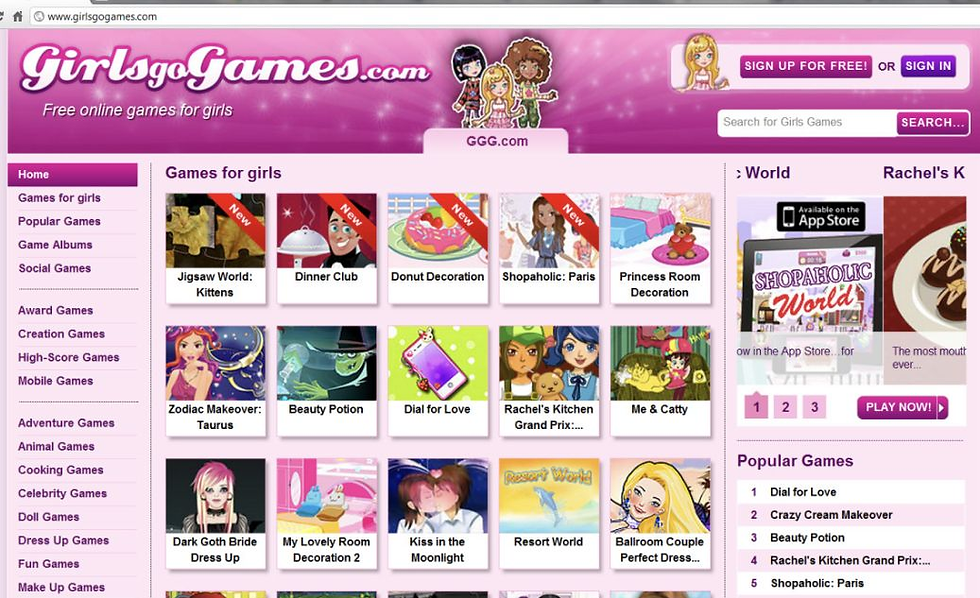


GirlsGoGames Original site

GirlsGoGames.com

GirlsGoGames.com was the ultimate hub for tween girls, and often, younger girls as well. Unlike the games mentioned earlier, GirlsGoGames did not provide any maps or live chat features, but instead hosted a massive collection of games ranging from cooking simulations to dress-up challenges and personality quizzes. On the surface, it appeared to be a wholesome, bubbly site filled with fun and creativity, but for many, it also served as an early, and often unintentional, introduction to more inappropriate content.

GirlsGoGames featured different categories of games to play, such as animal games, makeup games, and adventure games, but one category in particular stood out: kissing games. These games often involved three characters, where the objective was to make two of the characters flirt or kiss behind the back of the third character, who would usually be portrayed as a boss, teacher, or parent, without getting caught. Unsurprisingly, many parents weren’t in favor of their children playing games like these, which led to a common ritual of quickly exiting the browser when parents walked in, or deleting history to avoid getting in trouble.

That said, GirlsGoGames was still home to plenty of age-appropriate classics such as Sara’s Cooking Class, or the Polly Pocket games, my personal favorites. Looking back though, it’s clear that for many Gen Z kids, sites like this blurred the lines between harmless fun and questionable content. It makes you reconsider just how unfiltered and unsupervised our early internet experiences really were.


Poptropica Loading screen

Poptropica

Ending on a more positive note, we travel to the world of Poptropica, an adventure-based game where players explore islands and complete storylines unique to each island. This game wasn’t just fun; it was surprisingly educational. Created by Jeff Kinney, author of the Diary of a Wimpy Kid series, Poptropica featured narratives that introduced players to figures like Marie Curie, the first woman to win Nobel Prizes in both physics and chemistry, as well as immersive lessons on mythology, including stories of Greek gods such as Athena, Zues, and Poseidon. 

Though the game is still up and running today, it now offers a limited number of islands compared to its original run. The classic Poptropica experience included everything from light-hearted, easy quests to darker, more challenging adventures. For example, Cryptids Island, which featured the legend of the Jersey Devil, scared many young players with its eerie storyline. Another famously spooky island, Survival Island, based on the book The Most Dangerous Game, required players to escape a hunter stalking them through the wilderness. It terrified me as a kid, and it is still available to play.

Despite the reduced island count, Poptropica continues to draw in both old and new players. Many find themselves replaying islands they once struggled with as kids, discovering new meaning or finally solving puzzles that once seemed impossible. It’s a reminder of how even the simplest childhood games left a lasting impact, teaching us more than we realized at the time.
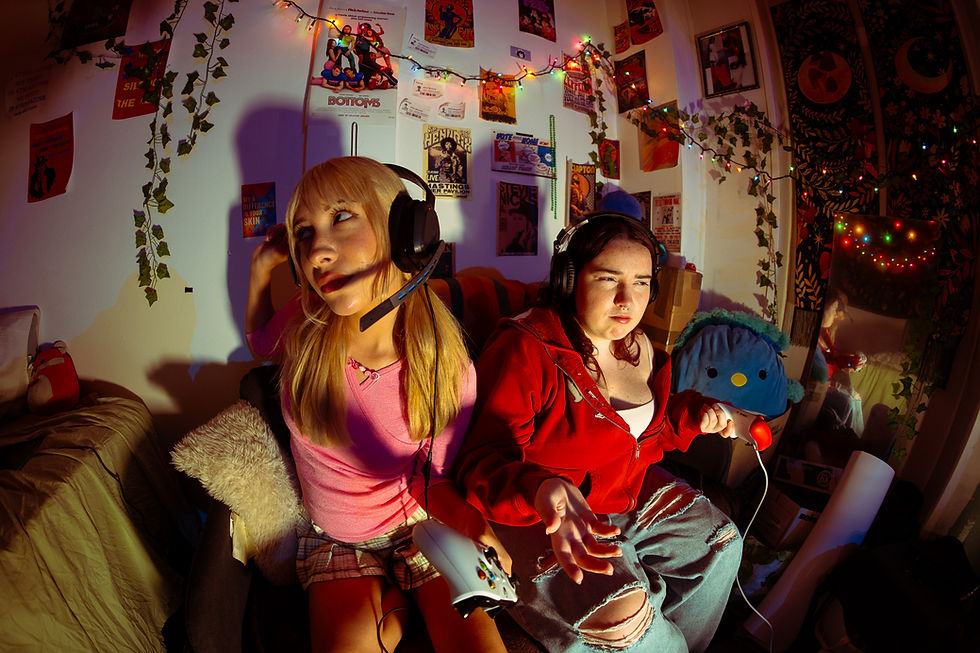

 Mini Issue 06:  GAMES! Photographed by Mark Bluemle
Mini Issue 06: GAMES! Photographed by Mark Bluemle

Overall, growing up in a world with technology already widely available and rapidly evolving came with both joy and risk. While many games were genuinely kid-friendly, others only appeared to be, making it all too easy for Gen Z to stumble into spaces they weren’t ready for.  With little supervision, many young users were exposed to inappropriate or even harmful content, from suggestive themes to online grooming, and experiences that left lasting impressions well into adulthood.


While it is nostalgic to revisit the games that once filled our afternoons with laughter and imagination, it’s equally important to reflect on how those early digital interactions shaped our sense of safety, trust, and identity. As Gen Z continues to navigate adulthood, carrying both nostalgia and caution, we’re uniquely positioned to push for safer, more thoughtful digital spaces, places where exploration and creativity are encouraged, but never at the expense of our well-being.


Photos of “The Expressionless,” “Squidward’s Suicide,” and “The Rake” from ScreenRant


Have you ever wondered if that willowy, black shadow outside of your bedroom window were a living being? The more you look at it, does it start to start to take the form of a tall, thin man? Is it looking directly at you? Have you ever felt slightly off when wandering around an empty, fluorescent-lighted hallway? Did you just hear something? Do you think that it saw you? Do you think that there’s still time for you to get away? Run.


These questions and the sense of unease that they may (or may not) have caused are a trademark of internet-based horror stories or “Creepypastas.” If you haven’t heard much about this niche genre of horror fiction, good. You were never supposed to. These stories are posted on online forums before being copied and pasted onto various platforms. The name is a play on the word “copypasta” (text that is repeatedly copied and pasted to different platforms) with a focus on horror stories being passed around. Creepypastas are not meant to be marketed to audiences in the same way that conventional horror movies and books are. Instead, you are meant to stumble across these stories completely unguarded before you realize that it’s too late to turn around now.


When you receive an email with the subject line “SMILE” at first, you probably think it’s Spam and go to delete it until you see an attachment entitled “smile.jpg.” You start to feel curious. It’s just a photo, what harm could it do? So, you click on it, and you see a photo that’s…odd. It’s a dark, grainy photograph of what looks like a Siberian husky with a wide grin showing a set of human teeth. Its white, piercing eyes glare at you, preventing it from looking too much like a regular dog. In the background is a disembodied hand seemingly trying to reach out and grab the viewer. Underneath is a caption that simply reads “SPREAD THE WORD.” You disregard the message at first, but then later that night the image is all you can see. You can’t stop thinking about it, dreaming about it, you will never sleep again. Not until you send that picture to someone else.


Photo of “Smile Dog” from Reddit

The story of “Smile Dog” is a classic example of a creepypasta. Line Henriksen describes such a story as a “digital urban legend…[aiming] to unnerve the reader, often engaging more or less directly with the themes of the paranormal.” The goal of a creepypasta and other internet-based horror stories is not to explicitly frighten the reader with a simple jump scare or gore, but to make the reader/viewer feel insecure. Images that are used are objectively not scary, but they are weird enough to be off-putting. For instance, Smile Dog is essentially just a photoshopped picture of a Siberian husky, but the grainy filter and human teeth make the photo unsettling to look at. Additionally, in an age where clicking on the wrong email could lead to serious consequences, the story preys on people’s fears of being targeted by some unseen, malicious force. The exact origins of the story are hard to confirm (though most attribute it to the Something Awful Forums) adding on to the lore of the story. Henriksen says that “creepypastas tend to be preoccupied with questions of authenticity, often presenting themselves as true stories that reveal some sinister truth about the world.” Unlike horror movies—which audiences are immediately told come from a production company—internet-based horror stories are purposefully ambiguous about their origins making audiences wonder if they are real after all.


These stories frequently take advantage of the digital platforms where they are published. One of the first well-known creepypastas, Ted the Caver (2001), took the form of a regular blog site dedicated to the titular narrator’s spelunking hobby. Caver uses the “found footage” trope found in horror movies such as The Blair Witch Project. Like “Smile Dog” the anonymous creator attempts to pass off the story as authentic. Updates were often irregular, as though entries were being sporadically uploaded by a real person. Readers were directed to new entries through a hyperlink that took them to a new page. Joseph Crawford describes the effect of Caver’s format as “[involving the audience] in a story which seems to be unfolding in real time, rather than something which had already concluded.” Instead of simply reading or watching a horror story, audiences are immersed into a horrific experience—one where the monster that they were just

reading about might be right behind them.


Ted the Caver blog site screenshot from creepypasta website.

The most famous example of an internet-based horror story blurring the lines between reality and fiction is that of Slender Man. Slender Man was first created on June 8, 2009, when the Something Awful forum posted a photography challenge prompting users to create “creepy-looking images” using photo manipulation techniques. Two days later, Eric Knudsen—under the username Victor Surge—responded with two black-and-white photographs showing groups of children with a tall, slender, blurred figure standing far behind them.


Photo from Reddit
Photo from Reddit

The blurred, black-and-white aesthetic of these pictures makes them look like they could be real. Instead of trying to create photographs that could pass as pictures taken in 2009, Knudsen purposefully chooses to make them appear as though they had been taken years ago, making them harder to verify. This façade of authenticity is further strengthened by the caption which claims that the photos were taken some time in the 1980’s and the photographers who had taken them had disappeared shortly afterwards. From there, more users contributed to the Slender Man narrative, sharing their own “encounters” with the monster. The most well-known of these stories being the YouTube series “Marble Hornets” which aired for three seasons from 2009-2014.


Photo from Wikipedia


Using the same “found footage” format as Caver, “Marble Hornets” follows Jay Merrick (show creator Troy Wagner) as he investigates the cause of his friend, Alex Kralie’s (co-creator Joseph DeLage) mental breakdown during the production of his titular student film. As the story progresses, viewers learn of how encounters with Slender Man led Kralie, and the other actors involved in the project, to lose their sanity as Slender Man took control of their minds. What really stands out about this series is how Wagner and DeLage continue the trope of partially obscuring the figure of Slender Man from the viewers’ sight. Whenever Slender Man (an actor wearing a stocking over their head and a dark suit) would get close to the cameras, the footage would immediately start glitching and become grainy until the video cut out altogether. Dr. Emily Zarka for PBS explains that “if you try to learn more about him or even think about him, it only makes it easier for him to find you.”


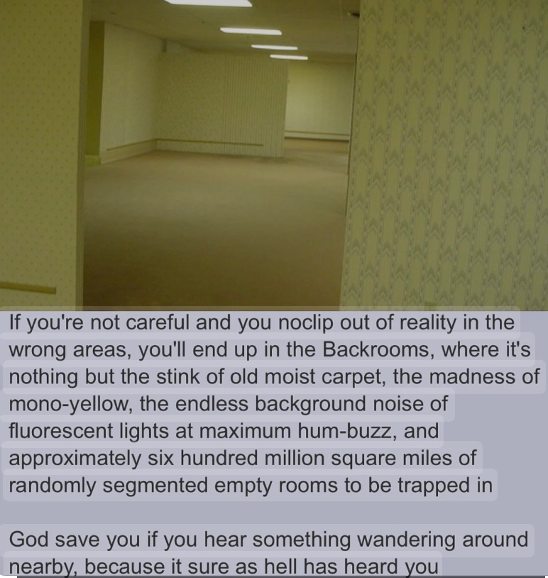
The fear that these stories generate all play with the idea there is a force that humans cannot control. Smile Dog highlights the speed at which information can be spread in the modern age and the idea of an unseen predator hiding behind our computer screens. Ted the Caver makes readers feel helpless as they are forced to read the story of a man slowly leading himself into danger. Slender Man is a stand in for strangers who may be looking to do us harm when we least expect them. However, there is still some agency in these stories. For instance, if you get a SMILE email, you can simply delete it. If a cave creeps you out, just don’t go inside it and as long as you refuse to acknowledge the existence of Slender Man, he can’t get to you. But one anonymous user recently managed to find the horror in empty spaces. The Backrooms appeared in 2018 on a 4chan thread calling for off-putting images. The user posted a simple photo of a completely empty, fluorescent-lighted office space with yellow wallpaper.


Photo with Caption from Reddit


Like Smile Dog, this image is not conventionally scary, but the creator plays on the aesthetic of making an image that unsettles rather that outright scares the viewer. Like Slender Man, the lore of the Backrooms is further developed by the caption underneath. Unlike these two monsters, there’s no individual action that attracts or makes someone more likely to end up in the Backrooms. A person enters when they “NoClip” or simply fall out of their plane of existence. In 2022, Kane Parsons (under the username Kane Pixels) would go on to start his own found footage series documenting the first-person experiences of various people who unfortunately ended up in the liminal space. In the series we that people NoClip to the Backrooms in the most unsuspecting circumstances. The first episode shows a cameraman who simply slips and falls into the Backrooms where he is pursued by an entity seemingly made of machine parts. In a recent episode, the character Ravi finds himself wandering around the Backrooms after going through a hole in his basement wall. The horror of the Backrooms is the complete loss of control and finding yourself in a place with no way of calling for help or any idea if anyone knows where you are. You don’t know when or why you fall into the Backrooms and if you’ll be able to find your way out.


What makes these stories so scary is the idea of learning something you were never meant to. That certain things should remain unknown, and to discover them would mean danger. Punitive danger too. A person knows better than to open unfamiliar email attachments, but our curiosity gets the better of us, and now they are cursed with nightmares until they pass their fate onto someone else. Ted ventured further into the cave, knowing that there was something evil lurking in the shadows. leaving readers with the promise of more answers, only to never be heard of again. The photographers who briefly captured the image of Slenderman vanished, and so will the next person who dares to remember the monster. Those who find themselves in the Backrooms are at its mercy until whatever it is that roams its halls finds them. We never think that we will be attacked when we feel at our safest. We like to tell ourselves that we know better than to put ourselves in dangerous situations, but we never consider that the danger may be coming towards us. We never think that the monsters and dark forces we read about—even in seemingly research-based articles—might be hiding around the corner, waiting to attack us.


(Slight Warning: Spoilers for The Walking Dead, Stranger Things, and The Bear


On May 6, 2004, millions of New Yorkers gathered in Times Square to experience the season finale of arguably the most famous sitcom of all time: Friends. After the episode aired, folks presumably chatted about their thoughts with their friends and family on the subway ride home, and furthermore with their coworkers in the break room the next day. Then we all moved on. 


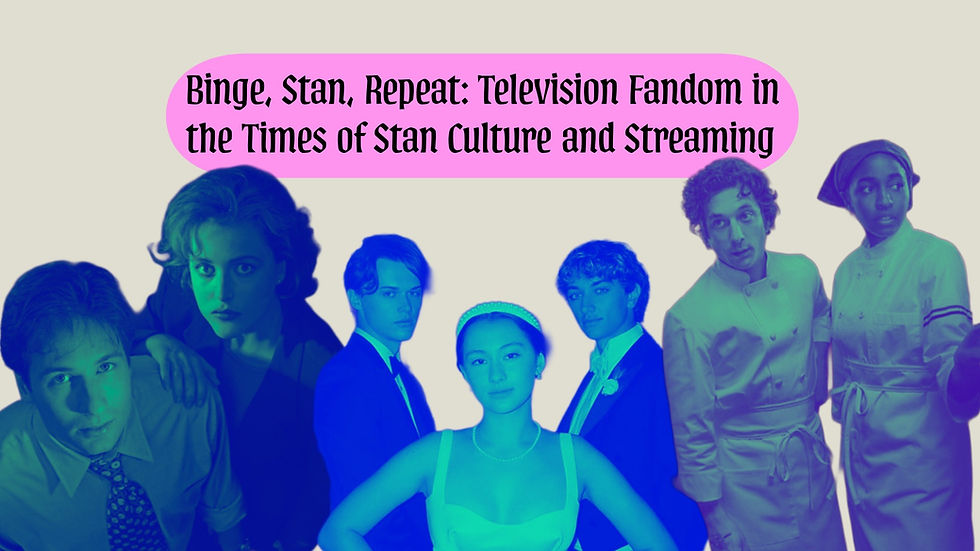
Television has a way of integrating itself into ever-changing pop culture. From the introduction of late-night television into the average middle-income home, to watchers across America voting for their favorite couple on Love Island USA every single week. Early instances of fans creating their own spaces for fellow viewers and showrunners alike can be attributed to the early days of Twitter. Immediately after the airing of the episode, it was no longer required to wait to communicate with your friends in real life. The second the credits began to scroll across the silver screen, fans could take their grievances or happiness to the world wide web for all to see. Fandom long existed before the time of social media or even the Internet. Showrunner and filmmaker J.J. Abrams describes the new world of television viewing as "akin to watching theater". The episodic release becomes something of a performance, and reactions would trickle in real-time. He goes on to add, “What was kind of great was that you could use it as one of your tools.” But where does this notion leave us in the current climate of all things streaming, whole-season releases, fandom existing on various platforms, media literacy declining, and so much more? 


Friends Series Finale In Times Square (2004)

What came of the fans’ criticism visibility is a change within the writer’s rooms. Suddenly, showrunners had become their own character. They were expected to represent their work in the same fashion that actors had been doing in the past. This is due to the new level of parasocial intimacy on Twitter. Writers, actors, and showrunners alike now had access to initial reactions and had the opportunity to not only engage in online discourse but take from it. Writers now had to dissect the difference between what fans think they wanted for their faves, to what was necessary to produce a decent series with a strong narrative.


Shipping is one of the more popular forms of engagement seen online, dating back to one of television history’s first “cult classics.” ‘The X-Files’ first graced screens in 1993, and Internet fans were quick to harbor a passion for the potential relationship between lead protagonists, Fox Mulder (Dave Duchovny) and Dana Scully (Gillian Anderson). While the show carried sentiments of critiques towards the American government and large institutions and embraced supernatural conspiracy theories, at the center of this show lies an intense coworker-to-lovers (kind of, it’s a little complicated) relationship between Mulder and Scully. 


Manifestations of shipping culture begin to trickle into reality, in which the actors face the repercussions of what exactly the fans want to see. Performers now exist as an extension of the series they are dedicating their professional life to. Rumors have long swirled about Anderson and Duchovny, from a famous clip of Anderson winning an award and celebrating by first kissing Duchovny then her boyfriend to the two continuously appearing on red carpets together. Every other summer, an influx of Conrad vs Jeremiah appears on the timeline and creates further discourse, despite the series ‘The Summer I Turned Pretty’ being an adaptation of a completed novel series, with an ending pre-written. While not always harmful, the extent to which shipping culture bleeds into the personal lives of actors emphasizes the issue of potentially too much involvement from fans. 


Fans of Netflix’s star show ‘Stranger Things’ have long noticed that Finn Wolfhard and Millie Bobby Brown rarely “interact” anymore, and many users online attribute this public awkwardness to the harassment from Mileven shippers. Fans of the on-screen couple furthermore shipped the actors, looking for public moments between the two to interrogate them about the status of a non-existent romantic relationship. Wolfhard and Brown rarely interact publicly, and users online speculate that the incessant shipping from fans early in the show’s run is a major part of that choice.  


Shipping has gone far beyond the streaming culture and fiction television series, where it can now be voted on every day from ‘Love Island USA’. American watchers choose their favorite couple in a similar fashion to how those early viewers of ‘The X-Files’ championed for the couple they desperately wanted to see online. This notion of “America decides” in conjunction with the way that fans can now guide television writers to make choices for their work in real time creates an entirely new question of whether fans of a show should have a say or not. Fans of the hit FX series ‘The Bear’ have long-campaigned for a romantic relationship between Syd (Ayo Edebiri) and Carmy (Jeremy Allen White). As the show continues to air episodes, the fans grow frustrated at the creators’ choice to refrain the two from ever getting together. Instead, the show created a unanimously despised girlfriend from Carmy’s past to deflect from the potential of “sydcarmy.” If a majority of viewership is rooting for one very specific thing, what would be the reason for the writers not to please their viewers? 


Shows that remained true to their planned plot point, such as ‘The Walking Dead’ killing fan-favorite character Glenn, lost a major chunk of their loyal fanbase from a decision that was unfavorable. Inversely, the ships and dramatics that surrounded ‘Outer Banks’ upon its newest season led many fans to believe that a crowd favorite character was killed off due to tensions on set. It was speculated that Madison Bailey and Rudy Pankow may have had a small and fleeting romantic relationship at some point throughout the filming of the early seasons, leading fans to ship not only the actors, but their characters as well. Initially, the character of Kie (Bailey) was meant to embark on a relationship with Pope (Jonathan Daviss). However, fans were not shy in their desire to see JJ (Pankow) and Kie end up together.


While the drama is largely speculation from fans and online users, there seems to be a slight correlation in the way that Bailey and Pankow chose to interact with one another publicly, as both were in separate relationships. It was alleged that the two could barely work together despite now having to perform as a romantic couple on-screen. 


The term “fan service” historically stems from manga books, in which artists and authors would lean into the riqué nature of the novels for the fans’ pleasure. The problem that fan service has found itself in is that it removes the original integrity of the writing and the natural progression of the narrative. Typical fan service instances revolve around heightened sexuality of characters or exploiting female bodies for the pleasure of a male-dominated audience, such as Princess Leia’s costume in Return of the Jedi, where she is clad in a tiny metal bikini, and enslaved with chains by Jabba the Hut. Other subsets of fan service come in the form of just doing what the audiences want and giving small jolts of excitement that will keep them slightly engaged. This can come in the form of letting two characters with a strong shipper fan base finally be together, or relying on references and nostalgia to keep fans happy, such as the case with Marvel’s latest endeavors. 


The change in the format in which television is consumed has also entirely shifted fandom culture and the way that content is discussed. In 2013, Netflix released their first-ever streaming exclusive series ‘House of Cards’ which changed the entertainment industry as we know it today. The days of weekly releases once a year on cable networks dwindled into a void of binging limited series or shows with eight episode seasons. The shift was gradual, of course, but it is impossible to look at the landscape of television without considering such a significant shift. HBO Max has stayed true to their model for the most part, opting to still release episodes on a weekly basis for their original streaming shows. The term “‘Euphoria’ Sundays” created a collective memory in the culture, and the service continues to find success within their weekly releases such as ‘The Last of Us,’ ‘Succession,’ ‘The Pitt,’ and more.  Netflix has now fully integrated a “parts” release system, in which they drop a few of the first half of one season at one point, then wait roughly a month or so to drop the other part. This model was highly impactful in the summer of 2022, where ‘Stranger Things’ felt inescapable. It was the show of the summer because it kept its momentum alive with the two different drops. 


Oftentimes, discourse around the steady decline of media literacy surrounds how audiences interact with the content and art they are actively consuming. Television writing consists of more telling than showing because the writers have lost faith in their readers’ intellect. The blurred line between actor, creator, and character that social media has created for stans has become a prominent issue for the developing nature of TV. 


You reached the end! Make an account to get updated when new articles and interviews drop.

bottom of page