My local library never stood out to me as a child. It didn’t smell of old vintage paperbacks or look like the perfect autumnal picture of academia that I would see in the movies. It stood on the main highway of my small Texas town, next to the courthouse and public pool. But there was always a piece of magic in every library visit.
Whether it was beaming as I turned in my completed summer library challenge to the librarian or sneaking upstairs to the young adult novel section as a child under twelve, it was an establishment that forever represented learning and discovering.
Its importance to me was highlighted in the latter half of 2020, a world somewhat attempting to recover from a local pandemic, and I, being a teenager, spent my final year of high school inside my childhood bedroom, restricted to the confines of scrolling on social media and streaming services. The Fridays when I was “let out” of school early were spent at the library, deciding my next movie (I was lucky with an insane number of Criterion DVDs for a smaller library) and my next novel for the week. It inadvertently became one of the most important rituals of my teenage years, and one I would continue to carry on into my adult life.
I moved to New York City in 2021, where the iconic Jefferson Market library of Greenwich Village remained under construction. The building is beautiful, representing all the ideas I had of a perfect library. Settled in the heart of one of New York City’s oldest and most coveted neighborhoods, the Gothic architecture of what was previously a church would have made the perfect space for a Sunday afternoon studying session, or a place for a tired parent to take their child for a free activity in one of America’s most expensive cities. However, in 2024, Mayor Eric Adams’ proposed fiscal budget included major financial cuts that would terminate Sunday services in branches of the New York Public Library across all boroughs.
Will Hermes, author and native New Yorker, spoke out against the calls on his X account (formerly Twitter), stating that it was “Straight up evil.” Hermes grew up in Eastern Queens, with the highlight of his week being his and his sister’s visit to the NYPL Central branch on Merrick Boulevard, in Jamaica, Queens. He says that cuts to the libraries on the weekends “starve precisely the communities with the least access to reliable information, and who need it the most.”
In a similar vein, Donald Trump’s administration has been hard at work to undermine and cut funding to public libraries across the country since the inauguration. In March of this year, Trump signed an executive order that calls upon the Institute of Museum and Library Services (IMLS) to eliminate “non-statutory components and functions.” The American Library Association (ALA) released a statement on March 15th, opposing the order just one day after it was signed, which highlighted ways that the allotted budget services well over 1.2 billion Americans for their in-person and virtual visits, which include: early literary development, summer reading programs, access to the Internet, braille and talking books for those with visual impairments, and much more. The statement was also a call to action, imploring that President Trump reconsider this decision, and it calls upon Americans to reach out to their elected leaders and simply show up for their libraries.
The conversation around the lack of third spaces for the younger generations has become more prevalent in the time of inflation and steadily increasing costs of living. Public spaces that require no contribution to capital are slowly decreasing through the actions of the Trump administration, and libraries seem to be one of its main targets. Aside from the educational value that having these spaces provides, they also aid in building stronger communities.
Photos of “The Expressionless,” “Squidward’s Suicide,” and “The Rake” from ScreenRant
Have you ever wondered if that willowy, black shadow outside of your bedroom window were a living being? The more you look at it, does it start to start to take the form of a tall, thin man? Is it looking directly at you? Have you ever felt slightly off when wandering around an empty, fluorescent-lighted hallway? Did you just hear something? Do you think that it saw you? Do you think that there’s still time for you to get away? Run.
These questions and the sense of unease that they may (or may not) have caused are a trademark of internet-based horror stories or “Creepypastas.” If you haven’t heard much about this niche genre of horror fiction, good. You were never supposed to. These stories are posted on online forums before being copied and pasted onto various platforms. The name is a play on the word “copypasta” (text that is repeatedly copied and pasted to different platforms) with a focus on horror stories being passed around. Creepypastas are not meant to be marketed to audiences in the same way that conventional horror movies and books are. Instead, you are meant to stumble across these stories completely unguarded before you realize that it’s too late to turn around now.
When you receive an email with the subject line “SMILE” at first, you probably think it’s Spam and go to delete it until you see an attachment entitled “smile.jpg.” You start to feel curious. It’s just a photo, what harm could it do? So, you click on it, and you see a photo that’s…odd. It’s a dark, grainy photograph of what looks like a Siberian husky with a wide grin showing a set of human teeth. Its white, piercing eyes glare at you, preventing it from looking too much like a regular dog. In the background is a disembodied hand seemingly trying to reach out and grab the viewer. Underneath is a caption that simply reads “SPREAD THE WORD.” You disregard the message at first, but then later that night the image is all you can see. You can’t stop thinking about it, dreaming about it, you will never sleep again. Not until you send that picture to someone else.
Photo of “Smile Dog” from Reddit
The story of “Smile Dog” is a classic example of a creepypasta.Line Henriksen describes such a story as a “digital urban legend…[aiming] to unnerve the reader, often engaging more or less directly with the themes of the paranormal.” The goal of a creepypasta and other internet-based horror stories is not to explicitly frighten the reader with a simple jump scare or gore, but to make the reader/viewer feel insecure. Images that are used are objectively not scary, but they are weird enough to be off-putting. For instance, Smile Dog is essentially just a photoshopped picture of a Siberian husky, but the grainy filter and human teeth make the photo unsettling to look at. Additionally, in an age where clicking on the wrong email could lead to serious consequences, the story preys on people’s fears of being targeted by some unseen, malicious force. The exact origins of the story are hard to confirm (though most attribute it to theSomething Awful Forums) adding on to the lore of the story. Henriksen says that “creepypastas tend to be preoccupied with questions of authenticity, often presenting themselves as true stories that reveal some sinister truth about the world.” Unlike horror movies—which audiences are immediately told come from a production company—internet-based horror stories are purposefully ambiguous about their origins making audiences wonder if they are real after all.
These stories frequently take advantage of the digital platforms where they are published. One of the first well-known creepypastas,Ted the Caver (2001), took the form of a regular blog site dedicated to the titular narrator’s spelunking hobby. Caver uses the “found footage” trope found in horror movies such as The Blair Witch Project. Like “Smile Dog” the anonymous creator attempts to pass off the story as authentic. Updates were often irregular, as though entries were being sporadically uploaded by a real person. Readers were directed to new entries through a hyperlink that took them to a new page.Joseph Crawford describes the effect of Caver’s format as “[involving the audience] in a story which seems to be unfolding in real time, rather than something which had already concluded.” Instead of simply reading or watching a horror story, audiences are immersed into a horrific experience—one where the monster that they were just
reading about might be right behind them.
Ted the Caver blog site screenshot from creepypasta website.
The most famous example of an internet-based horror story blurring the lines between reality and fiction is that ofSlender Man. Slender Man was first created on June 8, 2009, when the Something Awful forum posted a photography challenge prompting users to create “creepy-looking images” using photo manipulation techniques. Two days later, Eric Knudsen—under the username Victor Surge—responded with two black-and-white photographs showing groups of children with a tall, slender, blurred figure standing far behind them.
Photo from Reddit
The blurred, black-and-white aesthetic of these pictures makes them look like they could be real. Instead of trying to create photographs that could pass as pictures taken in 2009, Knudsen purposefully chooses to make them appear as though they had been taken years ago, making them harder to verify. This façade of authenticity is further strengthened by the caption which claims that the photos were taken some time in the 1980’s and the photographers who had taken them had disappeared shortly afterwards. From there, more users contributed to the Slender Man narrative, sharing their own “encounters” with the monster. The most well-known of these stories being the YouTube series “Marble Hornets” which aired for three seasons from 2009-2014.
Photo from Wikipedia
Using the same “found footage” format as Caver, “Marble Hornets” follows Jay Merrick (show creator Troy Wagner) as he investigates the cause of his friend, Alex Kralie’s (co-creator Joseph DeLage) mental breakdown during the production of his titular student film. As the story progresses, viewers learn of how encounters with Slender Man led Kralie, and the other actors involved in the project, to lose their sanity as Slender Man took control of their minds. What really stands out about this series is how Wagner and DeLage continue the trope of partially obscuring the figure of Slender Man from the viewers’ sight. Whenever Slender Man (an actor wearing a stocking over their head and a dark suit) would get close to the cameras, the footage would immediately start glitching and become grainy until the video cut out altogether. Dr. Emily Zarka forPBS explains that “if you try to learn more about him or even think about him, it only makes it easier for him to find you.”
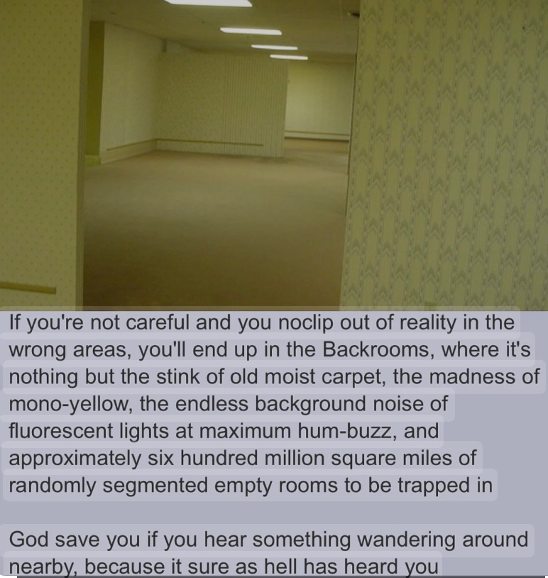
The fear that these stories generate all play with the idea there is a force that humans cannot control. Smile Dog highlights the speed at which information can be spread in the modern age and the idea of an unseen predator hiding behind our computer screens. Ted the Caver makes readers feel helpless as they are forced to read the story of a man slowly leading himself into danger. Slender Man is a stand in for strangers who may be looking to do us harm when we least expect them. However, there is still some agency in these stories. For instance, if you get a SMILE email, you can simply delete it. If a cave creeps you out, just don’t go inside it and as long as you refuse to acknowledge the existence of Slender Man, he can’t get to you. But one anonymous user recently managed to find the horror in empty spaces. TheBackrooms appeared in 2018 on a 4chan thread calling for off-putting images. The user posted a simple photo of a completely empty, fluorescent-lighted office space with yellow wallpaper.
Photo with Caption from Reddit
Like Smile Dog, this image is not conventionally scary, but the creator plays on the aesthetic of making an image that unsettles rather that outright scares the viewer. Like Slender Man, the lore of the Backrooms is further developed by the caption underneath. Unlike these two monsters, there’s no individual action that attracts or makes someone more likely to end up in the Backrooms. A person enters when they “NoClip” or simply fall out of their plane of existence. In 2022, Kane Parsons (under the username Kane Pixels) would go on to start his own found footage series documenting the first-person experiences of various people who unfortunately ended up in the liminal space. In the series we that people NoClip to the Backrooms in the most unsuspecting circumstances. The first episode shows a cameraman who simply slips and falls into the Backrooms where he is pursued by an entity seemingly made of machine parts. In a recent episode, the character Ravi finds himself wandering around the Backrooms after going through a hole in his basement wall. The horror of the Backrooms is the complete loss of control and finding yourself in a place with no way of calling for help or any idea if anyone knows where you are. You don’t know when or why you fall into the Backrooms and if you’ll be able to find your way out.
What makes these stories so scary is the idea of learning something you were never meant to. That certain things should remain unknown, and to discover them would mean danger. Punitive danger too. A person knows better than to open unfamiliar email attachments, but our curiosity gets the better of us, and now they are cursed with nightmares until they pass their fate onto someone else. Ted ventured further into the cave, knowing that there was something evil lurking in the shadows. leaving readers with the promise of more answers, only to never be heard of again. The photographers who briefly captured the image of Slenderman vanished, and so will the next person who dares to remember the monster. Those who find themselves in the Backrooms are at its mercy until whatever it is that roams its halls finds them. We never think that we will be attacked when we feel at our safest. We like to tell ourselves that we know better than to put ourselves in dangerous situations, but we never consider that the danger may be coming towards us. We never think that the monsters and dark forces we read about—even in seemingly research-based articles—might be hiding around the corner, waiting to attack us.
In the aftermath of the COVID-19 pandemic, a surprising cultural shift has emerged: a renaissance of reading. As digital fatigue and shortened attention spans became hallmarks of pandemic-era life, readers are rediscovering the transformative power of long-form storytelling. #BookTok and Instagram's reading communities have paradoxically reignited a hunger for deep, immersive literary experiences. What began as a survival mechanism during lockdowns—turning to literature for escape and connection—has blossomed into a robust reading culture. This literary revival signals a collective desire to reclaim depth, concentration, and the profound human connection that only a book can provide.
These five debut authors are finding eager audiences hungry for fresh perspectives, while readers seek meaningful narratives that offer more than fleeting digital distractions. Drop the dopamine chase and get back on track in 2025: embark on a literary journey through these five debut novels that promise to captivate, challenge, and redefine storytelling as we know it!
Colette Shade's "Y2K" is a razor-sharp cultural dissection of the early 2000s, exploring how seemingly frivolous elements such as AOL Instant Messenger, bling era rap, low-rise jeans, and body glitter reflected deeper societal shifts in a generation caught between technological optimism and impending economic collapse. The book offers a provocative meditation on a period that promised a bright future but ultimately birthed our complex contemporary moment.
In this poignant English-language debut, a Japanese author explores the unlikely bond between Chizu, a 20-year-old adrift in life, and Ginko, her 71-year-old eccentric relative, as they share a ramshackle Tokyo home punctuated by passing trains and resident cats. Through delicate, deadpan prose, the novel chronicles Chizu's journey from aimless part-time jobs and unsatisfying relationships to a hard-won independence, offering a microscopic examination of loneliness that captures the painful yet transformative process of finding oneself.
AJ Romriell excavates the intricate landscape of his personal metamorphosis, blending mythological allegory with raw personal narrative to explore the profound journey of shedding inherited religious constraints. Navigating the complex terrain between Mormon doctrine and queer identity, Romriell crafts a lyrical meditation on belonging, tracing his path from strict adherence to radical self-acceptance. The book emerges as a powerful testament to reimagining salvation—not as compliance, but as the courageous act of claiming one's authentic self.
Saou Ichikawa's "Hunchback" is a defiant, darkly comic exploration of agency and desire, centered on Shaka, a woman with a congenital muscle disorder living in a care home outside Tokyo. Through her razor-sharp wit and unapologetic inner life—publishing explicit fantasies, trolling social media, and challenging societal expectations—Shaka transforms her physical limitations into a powerful narrative of autonomy. This novel is a fierce, formally inventive testament to the boundless potential of the human spirit.
In this vibrant queer Jewish coming-of-age debut, Hannah and Sam embark on a transformative journey from Long Beach to San Francisco in 1996, navigating love, survival, and identity amid the city's queer landscape. When financial pressures push them into stripping at The Chez Paree, Hannah's encounter with Chris—an older butch lesbian—fractures her relationship with Sam and challenges her understanding of freedom and self-discovery. A tender, piercing exploration of first love, queer possibility, and the complex choices we make while searching for belonging.
Written by Natasha Lynn Baker
You reached the end! Make an account to get updated when new articles and interviews drop.