top of page

Hello, 47Club!


This issue is stunning! We have truly beautiful articles by everyone involved and even more on the way! I've known I wanted to do a pride issue forever, and I'm so happy with how it turned out. Our issues just keep getting more clean, and I am so so so excited to create our next one.


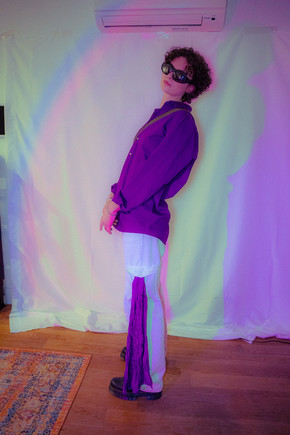
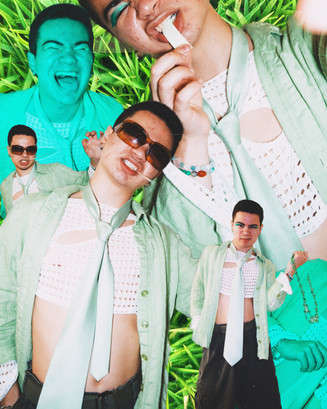
For this shoot, we wanted to capture each color of the rainbow. The main problem: how do we not make this look like a Target pride ad? And how do we not make this look... chugey.


We decided to go for a 90's zine editorial moment and I would say we did pretty well! The pictures were edited with warm tones and grains which enhanced the feel we were trying to go for. Jake and I also interviewed each model to give the shoot more personality.


I'll see you next month! Enjoy the shoot <3

ROYGBIV - The Issue 05 Shoot


RED - Melody Nguyen (She/Her)


How do you show pride?


"Coming from a traditional town and moving to New York City showed me how acceptance and diversity can completely change the atmosphere of a community. I show pride by continuously encouraging my friends around me to always be themselves and embrace what makes you different."


How can Pride Month inspire and encourage individuals who are struggling with their Pride?


"Pride Month is a time everyone, more than ever, can realize there’s an entire community that supports you for who you are. I personally am inspired and encouraged by my peers who stand for pride and see that it is ok to be part of the LGBTQ+ community and there’s nothing to be ashamed of. In fact, it’s something to be proud of."


Orange - Catalina Torress (She/Her)


How do you show pride?


"I show pride by being unapologetically myself, open, and accepting of everyone I meet. "


How can Pride Month inspire and encourage individuals who are struggling with their Pride?


"I think pride month can inspire and show individuals that being part of the LGBTQ+ community is something to be celebrated, embraced, and shared!"


Yellow - Ka'enaaloha Watson (She/Her)


How do you show pride?

"I show my pride by actively using my voice and my art, including fashion, acting, content creation, and film making to normalize the beautiful world of queerness. Being queer is beautiful, I show pride by being unapologetically myself in every space that I enter. I am all of my identities; native Hawaiian, a woman, and queer, I definitely make it known. As an actor and filmmaker, I choose to work on and create projects that highlight people of color and those in the lgbtq+ community. Supporting other queer individuals and artists specifically is one of the biggest ways that I and everyone can show their pride for being queer or support for queerness."


How can Pride Month inspire and encourage individuals who are struggling with their Pride?

"Pride month is a time for everyone of any sexual orientation and identity to be unapologetically who they are. It’s a time for self-expression, self-love, community building, and aloha. The queer community advocates for this all year, however a whole month dedicated to these ideals impacts many people's lives. Observing those who are comfortable in their skin gives others the confidence to follow in their footsteps. Pride is not just for big flashy clothing and parades (although very fun and an integral part), it centers around what is inside. It recognizes that everyone of every race, background, identity, and gender is loved and deserves love. Pride Month inspires those of every race, identity, and background. And while some may view Pride month as a time for only queer people, pride month has the extraordinary ability to inspire not only those in the queer community but everyone in the world."


Green - Jake Pranian (He/Him)


How do you show pride?


"I show pride by being proud of who I am every day. Not just as a queer person, but as an artist, performer, friend, lover, and as a human."


How can Pride Month inspire and encourage individuals who are struggling with their Pride?


"Pride is just one example for those who are questioning their sexual identity that regardless of who you love or how you like to express yourself, there will always be space for you in this community. You are loved unconditionally, and you can take as much time as you need to fully come to terms with what makes you feel comfortable."




Blue - Livia Hetes (She/They)


How do you show pride?


"I show pride by celebrating my own and others’ authenticity and individuality!"


How can Pride Month inspire and encourage individuals who are struggling with their Pride?


"Pride Month highlights a community that is so important to people who might be struggling with their sexual orientation or gender identity. Everything becomes easier when you have a support system."


Purple - Ady Karnacewicz (She/They)


How do you show pride?


"I show pride by surrounding myself with queer people that both make me feel safe and that I can look up to. Community is important for every type of person, but the queer community has a way of changing and saving lives by simply accepting people as they are."


How can Pride Month inspire and encourage individuals who are struggling with their Pride?


"Proper representation is one of the easiest and most important ways to make an individual feel seen. Seeing someone that dresses/acts/looks/lives their life in a similar way that you wish to makes anything feel possible. A lot of us come from places where our specific orientations were not reflected in any sense, so to see someone now publicly and unapologetically being themselves can give us the power to do the same."


Photographer: Mark Bluemle

Creative Director, Casting, Production Manager: Ka'enaaloha Watson

Production Assistant Jake Pranian

Photo Editing: Mark Bluemle and Ka'enaaloha Watson

Graphic Editing: Jake Pranian

MUA: Kindra Kirsh

Interviewed by Jake Pranian and Mark Bluemle

📍 47Magazine HQ


Murder, sexual assault, incest, and homosexuality. Taboo subjects in the 1970s, these acts and identities were celebrated in camp films such as The Rocky Horror Picture Show and Pink Flamingos. These films proudly displayed queerness in an era where homosexuality was anything but accepted. While revolutionary and successful among fringe audiences over 40 years ago, these films continue to have a cult following in the LGBTQ+ community.


What Actually is Camp?


Rocky Horror and the films by John Waters are frequently described as camp, yet the flexible usage of the descriptor in 2023 might make the meaning unclear. When I describe these films as camp, I mean it in the true, Susan Sontag sense of the word (not in the way Karlie Kloss infamously imagined it). As described in Sontag’s essay “Notes on Camp,” the word describes an ironic and theatrical expression of tackiness or distastefulness. It’s self aware, exaggerated, and intentionally misaligned with appropriate culture. The startling fashion and absurd politics of these midnight movies exemplify the concept of camp in a distinctly queer and rebellious way.


Midnight movies, which are cult classics made popular for being viewed in large groups at midnight, frequently feature queer characters and actors in drag. One of the most iconic examples of this is in The Rocky Horror Picture Show, featuring a “Sweet Transvestite” who alters the lives of a heterosexual couple (O’Brien).


The Rocky Horror Picture Show

Girl meets boy, boy proposes to girl, boy and girl get trapped in a sexually devious mansion owned by aliens… it’s a tale as old as time. While unsuccessful upon its release in 1975, The Rocky Horror Picture Show became incredibly successful within queer communities and its popularity has grown exponentially since the 70s. Many cities internationally still host live productions and frequent midnight screenings. It is considered to be a queer masterpiece, with no character idolized as highly as Frank-N-Furter (played by Tim Curry, not pictured). This “sweet transvestite” brings life to a beefier, blonder version of Frankenstein, Rocky, to be his new partner. With the accidental arrival of Brad and Janet (pictured in the center, Barry Bostwick and Susan Sarandon), things don’t go according to plan. Frank-N-Furter sleeps with both of them, kills the biker Eddie who interrupts the party, and is eventually murdered by alien siblings Riff Raff and Magenta (pictured on the left and right, Richard O’Brien and Patricia Quinn). Much of Frank-N-Furter’s behavior is unsympathetic, but Curry plays the role with a self-aware playfulness that guides the audience into a jovial and rebellious spirit.


The Early Works of John Waters

In the first act of John Waters’ Female Trouble, the character Aunt Ida (below on left, played by Edith Massey) cries, “The world of heterosexual is a sick and boring life!” Released in 1974, it is one of many films created by the filmmaker depicting the lives of the LGBTQ+ community as “filthy.” However, this presentation of filth is a source of pride for the odd characters within these worlds.


Before the charming PG-rated film Hairspray, filmmaker John Waters worked to bring disgusting campy filth to the movies. Working with a consistent cast of queer actors (spearheaded by drag queen Divine, pictured above in the center, who inspired the original Ursula design in The Little Mermaid), Waters made low-budget films that intersected queerness with socially unaccepted behavior. This is exemplified most clearly in Pink Flamingos from 1972 and Female Trouble. Divine stars in both, playing rebellious mothers who take pleasure in robbing, raping, murdering, and essentially any other immoral act imaginable. If it’s violent, sexual, and disgusting, her characters will take pleasure in doing them. Even the actor Divine ate real dog shit on the set of Pink Flamingos to prove that, “not only is she the filthiest person in the world, she’s also the filthiest actress in the world!” While the thought of watching a drag queen gag on dog poop doesn’t sound like traditional queer representation, LGBTQ+ audiences have created a huge cult following for these works.

(L to R, Divine, Mary Vivian Pearce, Mink Stole, David Lochary, John Waters, and Danny Mills on the set of Pink Flamingos)

1970s Queer Midnight Movies in the Modern Culture

Recognizing the political time these films were released and how the filmmakers have reflected on their work over the course of several decades is very relevant. Despite using outdated terms like transsexual and transvestite, members of the LGBTQ+ community including Lavene Cox (a transgender actress who played the role of Frank-N-Furter in 2016) still reveres Rocky Horror Picture Show as the meaning of these terms had a different context at the time of the film’s release in 1975. John Waters referenced regret in his 2010 memoirs, citing that his real-life fixation on Tex from the Manson murders and its influence on Female Trouble was insensitive. Divine and Tim Curry are cis male actors in drag. However, the nuances of their gender performance in these roles pose unique ideas about masculinity. The success all of these films found have been through fringe and alternative audiences. Divine says in Pink Flamingos, “I'm the filthiest person alive, that's who I am,” with pride.


This pride in devious acts was a form of rebellion against the openly homophobic culture of the era. Putting cannibalism and “lesbianism” in the same sentence describing Divine’s atrocities in Pink Flamingos emphasizes the absurdity of homophobia. Rocky’s heterosexual attraction towards Janet is treated with outrage and disgust similarly to how queer relationships would have been acknowledged in the 70s. These bold and exciting films paved the way for many LGBTQ+ films of the future, even if many of the LGBTQ+ characters of the 21st century don’t commit violent murders.


Written by Mary Leer


As I sit in bed for the third day in a row, I am surprised I have yet to develop bed sores on my side. I feel a noticeable layer of grease built on my face and taste how long it's been since I’ve brushed my teeth. Scrolling through TikTok for the third hour that day. The days seem almost routine in their dullness. Wake up, turn over, grab my phone, and start consuming. Before I know it, my interest has been piqued by a text I see come through on my phone. My cousin Mary, who recently has been gifted an iPhone, texts “How do I nair my arms?? The dance is tonight”.


Why this was so jarring to me, I don’t know, but regardless it forced me up from the perfect me-shaped indent I had left in my bed. Mary is soon to be an 8th grader, but when she comes to mind, I can only see her as the six-year-old who would throw temper tantrums at every restaurant we stepped foot in. I responded the way I would have liked to be responded to when I was 12, I asked why she was getting rid of her arm hair. She said she didn’t want thick body hair on the day of the dance, as if it would clash with her dress. A few hours later she had done it. This short exchange stuck in the back of my mind for the days following.


The first time I shaved my arms was during my freshman year of high school the day before homecoming. I remember the girl in front of me in English class turning around in her seat and showing me her arm hair, complaining and upset at how thick it was. Suddenly, I felt ashamed in my short sleeve shirt, the dark hair on my arm now an untamed forest. That night, I took my pink razor and ran it across the hair on my arm, watching the hair slide off onto the head of the razor. After I was done, I felt beautiful.


My mother always told me not to shave my arms, she taught me hair was there to protect my body. Still, at a time I can’t quite place, she lost me. Her advice stopped being valuable and started to be a hindrance. Why doesn’t she want me to be beautiful? Now, I can tentatively understand the toxic nature of these thought processes. Even as aware as I think I am, I still catch myself in the mirror wondering what I could change to be more like the models that I see in high fashion on Instagram.


From the first moment I held my baby cousin in my arms, I wanted her to be free. I wanted to save her from the anguish I knew men were to place on her. To save her from hours of poking and prodding herself in the mirror, the relentless cycle of self-hatred. Save her the hours spent bent over a bathroom scale, sucking on ice cubes, or diet fads promoted by the girl we think we want to be. I want to free her from all of it. From the pain, I know she's going to face. When I pass other women on the street I want to save her just as much. I want to offer this stranger my shoulder. I want to spend hours apologizing for the things I couldn’t stop from hurting her. Then, I want to collect the tears she spills onto the pavement. I would pocket these tears and place them on a tiny velvet pillow in my pocket. I would give one tear to my father when he asks me how I was victimized. I would give one to the woman behind the counter who sold me my first pregnancy test. I would give one to each of my younger sisters, to my roommate, to my mother. I would hold the last one for myself, as I watch it disappear into the cracks on my hand I would fight to forgive myself for all those I cannot save.


If I can track down in my memory, the first moment in my life when I felt I needed to change my physical body to be beautiful, maybe I can write the memory away. I would capture that moment like a lightning bug in my hand and the minute I committed it to paper the ground I stand on would crack. Then, the world would be irrevocably different. Every woman who read the story would leave these moments of pain behind, the systems built to cause us suffering would vanish. All the online videos of hidden lipstick tasers and anti-rape underwear would disappear, we wouldn’t need it anymore. Instead of receiving a stun gun for my 16th birthday I would look back at old photos and see a stuffed bunny. I would remember the softness of its fur, I would not be afraid of softness.


I know I cannot write this elogy. I cannot save myself or others from anything at all, but the wanting to is where I find comfort. The pride I find in womanhood is our commitment to saving each other. I cannot name an exact number of the many nights I’ve spent in bar bathrooms being told or telling another woman that she deserves better, usually while I am holding her friend's hair back over the toilet. Even though we are unknown to each other and have had too much tequila, it feels cosmic that we want so badly to tell the other that we love them. Women are never truly strangers to one another. Whenever I meet a woman, I can see in her eyes where our pain is shared.


Through all of its bloody sacrifice, I am proud to be a woman. The world is trying to kill us, all of us, and yet we keep going. I could easily let the world make me hard, and yet we earn our softness and continue to love despite the sacrifice it takes to do so. I want nothing more than to continue to fight, not just for me, but for us. Womanhood will always be us. Whenever I speak of myself, I also speak of my mother and my grandmother. I speak of all the women who fought to put me here, who fought to give me just a little bit more power than they had. The women I recognize in my face when I smile. The woman who gave me my nose and hips. The women who hold me and collect my tears.


For us: I will keep going.


Written by Liadin Stewart


You reached the end! Make an account to get updated when new articles and interviews drop.

bottom of page