top of page

(Slight Warning: Spoilers for The Walking Dead, Stranger Things, and The Bear


On May 6, 2004, millions of New Yorkers gathered in Times Square to experience the season finale of arguably the most famous sitcom of all time: Friends. After the episode aired, folks presumably chatted about their thoughts with their friends and family on the subway ride home, and furthermore with their coworkers in the break room the next day. Then we all moved on. 


Television has a way of integrating itself into ever-changing pop culture. From the introduction of late-night television into the average middle-income home, to watchers across America voting for their favorite couple on Love Island USA every single week. Early instances of fans creating their own spaces for fellow viewers and showrunners alike can be attributed to the early days of Twitter. Immediately after the airing of the episode, it was no longer required to wait to communicate with your friends in real life. The second the credits began to scroll across the silver screen, fans could take their grievances or happiness to the world wide web for all to see. Fandom long existed before the time of social media or even the Internet. Showrunner and filmmaker J.J. Abrams describes the new world of television viewing as "akin to watching theater". The episodic release becomes something of a performance, and reactions would trickle in real-time. He goes on to add, “What was kind of great was that you could use it as one of your tools.” But where does this notion leave us in the current climate of all things streaming, whole-season releases, fandom existing on various platforms, media literacy declining, and so much more? 


Friends Series Finale In Times Square (2004)

What came of the fans’ criticism visibility is a change within the writer’s rooms. Suddenly, showrunners had become their own character. They were expected to represent their work in the same fashion that actors had been doing in the past. This is due to the new level of parasocial intimacy on Twitter. Writers, actors, and showrunners alike now had access to initial reactions and had the opportunity to not only engage in online discourse but take from it. Writers now had to dissect the difference between what fans think they wanted for their faves, to what was necessary to produce a decent series with a strong narrative.


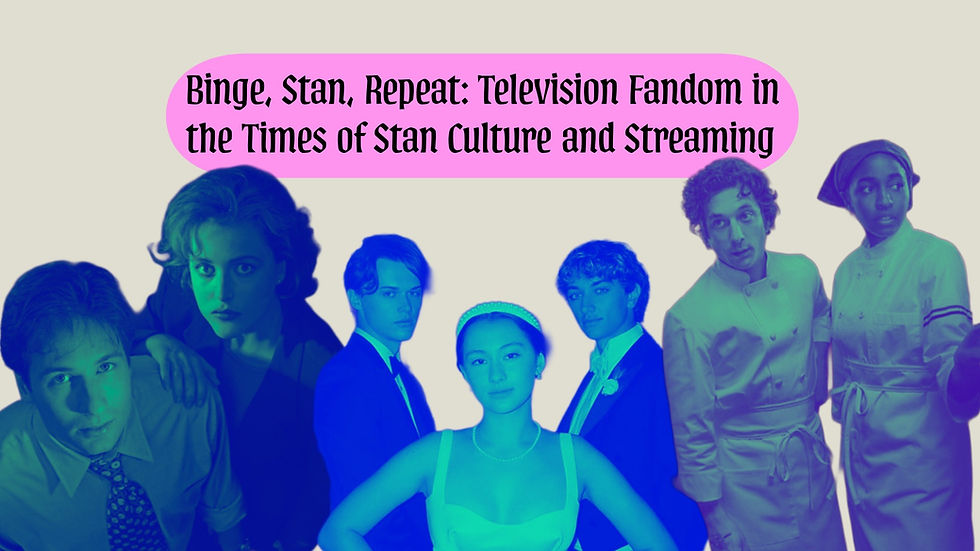
Shipping is one of the more popular forms of engagement seen online, dating back to one of television history’s first “cult classics.” ‘The X-Files’ first graced screens in 1993, and Internet fans were quick to harbor a passion for the potential relationship between lead protagonists, Fox Mulder (Dave Duchovny) and Dana Scully (Gillian Anderson). While the show carried sentiments of critiques towards the American government and large institutions and embraced supernatural conspiracy theories, at the center of this show lies an intense coworker-to-lovers (kind of, it’s a little complicated) relationship between Mulder and Scully. 


Manifestations of shipping culture begin to trickle into reality, in which the actors face the repercussions of what exactly the fans want to see. Performers now exist as an extension of the series they are dedicating their professional life to. Rumors have long swirled about Anderson and Duchovny, from a famous clip of Anderson winning an award and celebrating by first kissing Duchovny then her boyfriend to the two continuously appearing on red carpets together. Every other summer, an influx of Conrad vs Jeremiah appears on the timeline and creates further discourse, despite the series ‘The Summer I Turned Pretty’ being an adaptation of a completed novel series, with an ending pre-written. While not always harmful, the extent to which shipping culture bleeds into the personal lives of actors emphasizes the issue of potentially too much involvement from fans. 


Fans of Netflix’s star show ‘Stranger Things’ have long noticed that Finn Wolfhard and Millie Bobby Brown rarely “interact” anymore, and many users online attribute this public awkwardness to the harassment from Mileven shippers. Fans of the on-screen couple furthermore shipped the actors, looking for public moments between the two to interrogate them about the status of a non-existent romantic relationship. Wolfhard and Brown rarely interact publicly, and users online speculate that the incessant shipping from fans early in the show’s run is a major part of that choice.  


Shipping has gone far beyond the streaming culture and fiction television series, where it can now be voted on every day from ‘Love Island USA’. American watchers choose their favorite couple in a similar fashion to how those early viewers of ‘The X-Files’ championed for the couple they desperately wanted to see online. This notion of “America decides” in conjunction with the way that fans can now guide television writers to make choices for their work in real time creates an entirely new question of whether fans of a show should have a say or not. Fans of the hit FX series ‘The Bear’ have long-campaigned for a romantic relationship between Syd (Ayo Edebiri) and Carmy (Jeremy Allen White). As the show continues to air episodes, the fans grow frustrated at the creators’ choice to refrain the two from ever getting together. Instead, the show created a unanimously despised girlfriend from Carmy’s past to deflect from the potential of “sydcarmy.” If a majority of viewership is rooting for one very specific thing, what would be the reason for the writers not to please their viewers? 


Shows that remained true to their planned plot point, such as ‘The Walking Dead’ killing fan-favorite character Glenn, lost a major chunk of their loyal fanbase from a decision that was unfavorable. Inversely, the ships and dramatics that surrounded ‘Outer Banks’ upon its newest season led many fans to believe that a crowd favorite character was killed off due to tensions on set. It was speculated that Madison Bailey and Rudy Pankow may have had a small and fleeting romantic relationship at some point throughout the filming of the early seasons, leading fans to ship not only the actors, but their characters as well. Initially, the character of Kie (Bailey) was meant to embark on a relationship with Pope (Jonathan Daviss). However, fans were not shy in their desire to see JJ (Pankow) and Kie end up together.


While the drama is largely speculation from fans and online users, there seems to be a slight correlation in the way that Bailey and Pankow chose to interact with one another publicly, as both were in separate relationships. It was alleged that the two could barely work together despite now having to perform as a romantic couple on-screen. 


The term “fan service” historically stems from manga books, in which artists and authors would lean into the riqué nature of the novels for the fans’ pleasure. The problem that fan service has found itself in is that it removes the original integrity of the writing and the natural progression of the narrative. Typical fan service instances revolve around heightened sexuality of characters or exploiting female bodies for the pleasure of a male-dominated audience, such as Princess Leia’s costume in Return of the Jedi, where she is clad in a tiny metal bikini, and enslaved with chains by Jabba the Hut. Other subsets of fan service come in the form of just doing what the audiences want and giving small jolts of excitement that will keep them slightly engaged. This can come in the form of letting two characters with a strong shipper fan base finally be together, or relying on references and nostalgia to keep fans happy, such as the case with Marvel’s latest endeavors. 


The change in the format in which television is consumed has also entirely shifted fandom culture and the way that content is discussed. In 2013, Netflix released their first-ever streaming exclusive series ‘House of Cards’ which changed the entertainment industry as we know it today. The days of weekly releases once a year on cable networks dwindled into a void of binging limited series or shows with eight episode seasons. The shift was gradual, of course, but it is impossible to look at the landscape of television without considering such a significant shift. HBO Max has stayed true to their model for the most part, opting to still release episodes on a weekly basis for their original streaming shows. The term “‘Euphoria’ Sundays” created a collective memory in the culture, and the service continues to find success within their weekly releases such as ‘The Last of Us,’ ‘Succession,’ ‘The Pitt,’ and more.  Netflix has now fully integrated a “parts” release system, in which they drop a few of the first half of one season at one point, then wait roughly a month or so to drop the other part. This model was highly impactful in the summer of 2022, where ‘Stranger Things’ felt inescapable. It was the show of the summer because it kept its momentum alive with the two different drops. 


Oftentimes, discourse around the steady decline of media literacy surrounds how audiences interact with the content and art they are actively consuming. Television writing consists of more telling than showing because the writers have lost faith in their readers’ intellect. The blurred line between actor, creator, and character that social media has created for stans has become a prominent issue for the developing nature of TV. 


From a young age, we are asked what we want to be when we grow up, and our minds are filled with endless possibilities. As the years pass, those dreams slowly fade, until one day we are left with a pervasive sense of panic. Having no clue of who we are and what we want to do with the rest of our lives. Some people look back at their 20s, often through rose-tinted glasses, calling them "the best years of their lives", but in truth, they might just be the scariest, often filled with immense pressure and uncertainty.


Mid-20s Crisis offers a fresh take on the timeless challenges of being in your 20s. Following four roomates, Iris, Amy, Rex and Danielle, trying to navigate their careers, dating, and figuring out how to be a functioning adult. All while crammed into a 3-bedroom apartment in New York City. The series follows these girls through these treacherous years, and how you can get through all the chaos and joys of adulthood with friends struggling as well by your side. 


Amid her own mid-20s crisis, Rucci found inspiration to write from conversations she shared with friends. "I started writing because I was with my friends, and always would spiral because XYZ is moving, traveling around the world, and got engaged. Things were happening in my life that I don't know what to be doing right now, so let's write about it." Rucci went on to explain how she was watching Girls at the time, a timeless series about trying to make sense of life after college from the early 2010s. She wanted to create a show capturing this generation, post-pandemic young adults." 


Originally filmed as a proof of concept, it was screened at numerous film festivals earlier this year. Then this past May, Rucci hosted a live table reading at LA MAMA Theatre to showcase the the first 8 episodes of the series. She assembled a stellar cast that brought the script to life. The four lead actresses' chemistry made it feel as if I was watching a real friend group unpack their day with each other.  They weren't afraid to get messy, from breaking out into a complete dance party to letting out demonic screams, capturing the array of emotions that come with being a young adult. Displaying the vast freedom of lack of responsibility and living with friends, while on the other end, feeling the frustrations of adulthood.


Throughout the series, each of the girls faced a variety of struggles and hardships, from the challenges of dating to going celibate, trying not to lose their job due to their digital footprint, and the journey of being a free spirit (as well as free loading) with the IRS on their tail. No matter the scale of these problems, the show highlights that you can get through any challenge with the right friends by your side. For some it may be experiencing your first heartbreak like Rex, or like Amy getting her pap smear with Iris by her side. Rucci shares how her own friendships contributed to the series. "My initial inspiration was the conversations I was having with my friends at the time, but also the conversations we had that we wouldn't talk about with other people, like what birth control we're on, a weird ex-boyfriend. Things that I found interesting but could be fun." Among all the silliness, Rucci balances these comedic beats with darker moments. Not shying away from the unsaid dangers of dating, such as grooming and sexual assault. 


What is most unique about this generation’s experience compared to previous ones is taking place in the digital age. The series perfectly captures the current reality of being a young adult with the world wide web, taking a timeless problem, such as trying to establish a career or working odd jobs, and displays the creative ways to make money online. Of the four girls, three use the World Wide Web for various jobs, from selling feet pictures, hosting online holistic workout classes, to trying to become an influencer. 


With today's hyper consumption of content, it is a slippery slope to include internet trends or viral moments. They easily make a film or movie feel outdated as they attempt to be on trend. Rucci expressed her distaste for current Gen-Z shows that mark themselves as too timely and how cautious she was when writing this series. "My friend Anna, who helped me produce it, played Iris in the reading. She said I should watch [censored] because there are a lot of jokes in there that would've worked 3 months ago if it came out then. After all, it was relevant then. If you go through your script, make sure you don't include jokes that cover one viral TikTok everyone in the world watched and got over. Then your show comes out and it's not funny anymore…"


As I left the theater craving for more, in the lounge area, I found myself in the midst of an

immersive experience. Walls decorated with posters, Polaroids, or interactive boards to share your own mid-20s crisis. What left me speechless was the mural of memorabilia that perfectly captures the inner mind of a current 20-something woman. With pictures of heart-throbs such as Pedro Pascal and Josh O'Connor, to romance books such as Normal People and A Court of Thorns and Roses, to a hot pink vibrator and quotes from the script, such as "Fame is the American Dream".  


If you are craving to see this show on the big screen like I am, follow Mid-20s Crisis on

to stay up to date on the show’s development and see clips from the live table reading.


Written By Ashley Murphy

Photos By Cat Washington


At this point, I dare you to try and invent a new kind of “girl” aesthetic that no one else has thought of. Click on that hyperlink that you’ll find a non-exhaustive list of all the different kinds of “girls” that have walked out of the revolving door of TikTok’s digital wonderland into the mainstream. But, there is one girl that hasn’t been mentioned in this list and that’s the Anime Girl–undeniably, the original “girl” aesthetic who has quietly ruled the hyper-feminine fashion scene since the ‘90s. From the kawaii aesthetic to the outfits worn in Sailor Moon, anime girls have frequently been made by and for the girls.


Of course, at the heart of all of this is a growing embrace of femininity after years of being told that to be “girly” meant to be vapid, unserious, or–God forbid–like the other girls. Ebony-Renee Baker explains that “the hyper-feminine aesthetic isn’t about specific styles or colors, nor is it catered to a particular gender. This trend is about embracing the concept of girlishness in your everyday [life].” To be hyper-feminine is about giving in to all the the “girly” things that we loved when we were younger and to break out of the expectation that once we hit a certain age, we have to trade out shades of pink for beige. Lauren O'Neil adds that the rise in popularity of hyper-feminine fashion can also be viewed as a “backlash against a tendency towards highly practical trends in millennial fashion.” There is a desire to dress for joy and self-expression rather than to solely look “presentable”. 


Enter anime girls. O’Neil explains the influence that anime had on hyper-feminine aesthetics writing “Tumblr-as well as anime and manga cartoons and comics before it- was also part of the cross-cultural dissemination of kawaii aesthetics (kawaii translated as cute in Japanase, and encompasses things like Hello Kitty and sailor cosplay).” Female anime characters–and their creators– embraced fashionable, feminine clothing, drawing inspiration from real-life designs. In an article from Vogue Singapore, Azrin Tan describes how Sailor Moon creator, Naoko Takeuchi, would reference the creations of prominent designers in the ‘90s such as Thierry Mugler and Christian Dior. She also incorporated popular clothing trends of the time such as “crop tops, high-chromatic ensembles and preppy sweaters of waistcoats.” Takeuchi balanced the high-fashion looks with stylish, casual ensembles that any teenage girl at the time could wear herself. 


Along with Takeuchi, Ai Yazawa would take inspiration from Vivienne Westwood  when dressing her iconic goth-girl, Nana Osaki in the anime of the same name. Tan explains that Yazawa would dress Nana in pieces such as “corset bustiers, ripped stockings underneath pleated tartan blazers and Westwood’s signature ‘Rocking Horse’ platforms.” The beauty of these characters’ styles stemmed from the artistry behind the outfits. Not all of the clothes they wore may have been the most practical, but practicality was not the point. O’Neil elaborates on this point, writing that the rise of hyper-femininity “could also be seen as a backlash against a tendency towards highly practical trends…the delicate look of a satin shoe or a soft pair of grey socks feels like an embrace of clothes for their own sake, and of style for fun and joy.” Fashion was being used as an art form for these characters to express their personalities in a unique way rather and encouraged those watching to do the same. 


Outside of individuals’ style, anime fashion has managed to break into the real world by way of design collaborations. Ekta Sinha explained that “the influence of anime on high-end brands is undeniable; every year, we notice a luxury brand introducing a fashion line inspired by a particular anime series.” Sinha cites the examples of Jimmy Choo launching a shoe line inspired by Sailor Moon characters and Dior’s photo series depicting models, Tatsuya Endo and Cocumi Kimura, wearing clothing inspired by characters from the anime, Spy x Family


A lot of this is also owed to the fact that celebrities are embracing their love of anime, moving the genre away from niche corners of the internet and into the mainstream. In a TeenVogue article aptly titled “Is Anime 'Cool' Now?,”  Sarah Delgado lists celebrities such as Megan Thee Stallion, Hunter Schafer and Ariana Grande who “proudly [show off] their anime-inspired cosplays, tattoos, and manicures online.” Simply put, yes, Anime is “cool” which has allowed its fashions–despite already being around for years–to be showcased and appreciated by the general public that once shunned it away. Sailor Moon aired in 1992 and Nana’s first episode was released in 2006, their creators have been looking to runways for artistic inspiration for years, but it’s not until mainstream, fashionable celebrities embrace their love of anime that cosplaying can move out of the convention hall and onto a Dior photoshoot.


In anime, the girls could wear the clothes of their dreams and the girls who watched admired their astounding styles. Tan describes anime as a place “where monsters can speak, bubblegum pink hair is a genre mainstay and your clothes can be as fantastical as you’d like them to be.” Outside of the fantasy elements, part of the appeal was escaping to a world where a teenage girl casually had access to Vivienne Westwood corsets and Chanel dresses that remained impeccable even as she ran around saving the world. 


Written by J.D. Valdepenas

Photography by Roberto Meadows

Director: Jazzi Almestia

Production: Mickayla Davis

PA, Styling: KateLynn Herrera

Talent: Lily Forsyth, Finn Lyman, Gabrielle Clemons, Precious

You reached the end! Make an account to get updated when new articles and interviews drop.

bottom of page