top of page

At the top of spring, fashion fanatics on social media begin their preparation for the first Monday of May. The Met Gala, its yearly theme, and the guest list become the hottest topics of the season. While many look forward to a new red carpet with some of the most robust displays of high fashion in America, many use this time to remember the iconic 2018 gala, highly revered as one of the best.


The theme was “Heavenly Bodies: Fashion and the Catholic Imagination,” and opulence was the star of the show. The Metropolitan Museum of Art describes the exhibit as “a dialogue between fashion and medieval art from The Met collection to examine fashion's ongoing engagement with the devotional practices and traditions of Catholicism.” The display featured garments never seen outside the Vatican, and was staged for anyone to see. 


With a consistent obsession for the one-year exhibit, one has to wonder about the meaning of Catholic-specific devotion through clothing. Gen Z and their never-ending subculture aesthetics have created ways for worship, or a subversion of subscription to religion, to be stylized. From “tradcath coquette” and the aesthetics of “Ethel Cain core” to the rise of conservatism amongst a younger generation, the 2020s have proven themselves to be a slightly confused time for Catholicism. There’s an evident tug of love and hate from both ends of the spectrum of belief. What lies within the grey area, however, is fashion. 


Clothing has been an important staple in creating the status of Catholicism. As “Heavenly Bodies” explores, the Catholic fashion in medieval Europe became an important marker for how important cloth itself was to become within the church. In her essay, “The cardinal’s new clothes?” Emma Anderson explains how rags and simple garments were integral to bridging the gap between heaven and earth. Both Jesus Christ and his mother, the Virgin Mary, were ascended into heaven, leaving all of their clothes connected to their holy bodies, in a sense. In the following centuries, Catholic fashion aided in the establishment of its cultural hierarchy. The opulence that was evident in the robes that adorned cardinals and bishops, painted in royal pigments of crimson and purple, respectively. This display is meant to celebrate the majesty of God’s presence in this world, acting as an extension of the heavens. It also stands as a representation of the power and continuity that the institution of the Catholic Church has held over time. 


Totems from the Catholic Church play a large role in the manner in which its followers wear their worship. Representations of the Virgin Mary or imagery of the Crucifixion are circulated in the current landscape of how Catholicism is aestheticized for the new digital age.


While the Met’s 2018 display of Catholic fashion is a prominent mark for the current rise of Catholic aesthetics in cool girl fashion, it has slowly infiltrated algorithms for years and has culminated in an entirely new subculture. The fetishization of the religion can be tied to the fact that it stems from material culture where the physical pieces of memorabilia are meant to tie its followers to the divine. This makes the allure of the fashion pieces themselves enticing to those who either practice the way of the church or who grew up in and around it. 


The subversion of Catholic symbols in media dates back to the mid-1900s, implementing itself into mediums like film and music, which is inevitably how they trickled their way down into alternative fashion. From Rosemary’s Baby (1968) to Madonna’s “Like A Virgin,” the scandalizing nature of defying Catholicism’s core values are enough to ruffle the feathers of the general public. The iconography in conjunction with the highlighting of sins is enough for fans of pop music and horror films alike to follow in the footsteps of the potential blasphemous representation of their worship. Developments into the modern stan area are best highlighted in the Lana del Rey fandom space, in which her use of religious imagery in lyrics has created a correlation to what is now coined the #catholicaesthetic.


In the publication TeenInk, user pim2109 cites Del Rey’s “glamorization of passivity in the face of abuse” as a large reason that a younger audience is translating that into an aestheticized version of the concepts that surround the practice. The religious imagery and memorabilia no longer represents suffering nor does it bring followers closer to heaven, as previously proposed or even intended in the Middle Ages during the rise and domination of the Catholic church. It now visualizes submission of women, the devout followers, to a male authoritative figure, God himself. 


In a now deleted Tumblr post, musician Ethel Cain claimed we exist in the time of an “Irony Epidemic.” The singer wrote: “there is such a loss of sincerity and everything has to be a joke at all times.” The venn diagram of Ethel Cain stans and Lana del Rey fans likely has a larger crossover than many may realize, and while Cain is not necessarily speaking on her fanbase or the people that use the visuals that accompany her 2022 concept album, Preacher’s Daughter, the theory of the irony epidemic rings true to the aestheticization of Evangelicalism. The #ethelcaincore comes from fans taking the sole visuals and their own personal applications of the themes from Preacher’s Daughter (cannibalism, living in the American south, being raised religious/ Christian, etc.) and applying them to carousels on their personal grid. While Cain’s album centers on Christianity (and more likely, Southern Baptist) and its values that work to disrupt a home life and family, many have blurred the lines due to the Southern Gothic tone of the album and the connection of that particular aesthetic to Catholicism.


The irony, then, of practicing faith itself becomes relevant. 


Another major player in the influence of Catholicism in Gen Z fashion is the “Dimes Square” niche scene in New York City. Controversial figures and podcast hosts Honor Levy and Dasha Nekrasova have made their faith to the Catholic church public, and many online believed that their practice of the religion was insincere and being done in an ironic manner, where Catholicism is more of a vibe rather than a call to devote their life to faith. However, on a podcast, when asked about her choice to convert to the faith, Nekrasova states, “I think a lot of people think I’m being Catholic, ironically, which is not true. But it doesn’t really matter if you’re doing something ironically, because it still works.” Levy also mentioned on her “Wet Brain” podcast that if you perform enough rituals, “...then it becomes real, even if you don’t believe in it.” In this way, the religion finds itself a part of the irony epidemic. 


Low-resolution flash images of moss growing over the Virgin Mary or billboards that litter the Bible belt that call for drivers to be saved by Jesus Christ have become a hashtag subculture on social media. So where does this leave room or worship in the world of fashion? Shocking numbers of red votes in the 2024 presidential race that came from Gen Z confirms what many have theorized online: Conservatism is, and has been, on the rise. The life-altering event of the pandemic caused young people across the world to reckon with themselves in the space they grew up in, facing the parts of themselves that may have been buried in routine and life pre-2020. 


In a search for truth, community, and meaning in a world that continues to fail an entire generation, Catholicism finds itself on a steady increase in young people. This fact of Catholicism and, more importantly, its values on the rise in tandem with the attempt to subvert the practice by satirizing or aestheticizing it leaves too much room for ambiguity. Fear of AI and the unknown can lead many to revert back into a practice that feels traditional, and for those who were raised religious, it feels like a return to youth. The rosary no longer exists as a binary from a string of beads that count our prayers to a fashion statement that embodies female sexuality (a la Madonna) and having a cross hanging in your bedroom could be done in spirituality or in reference. The spectrum of devotion to rebellion of the Catholic church has grown immeasurably broad, and the same can be said for its fashion trends.

Is a country built on hypocrisy and deception capable of standing as

“One nation under God”? 


This question lingers in my mind daily as I continue growing into a self-liable citizen. Christianity sits as America’s predominant religion. As much as I’d love to believe it to be purely out of discipleship, the truth is quite the opposite. This country’s foundation, as some may know, is based on the Discovery Doctrine, a common practice of conquest and conversion. With conquest comes power above all else– above religion and above the people. Today, this system has rebranded itself as Christian Nationalism, a political ideology that works to fuse Christian religion and national identity together. This is the same driving force that has used the bible to justify disposition of indigenous peoples, slavery amongst nations, and authoritarian governments.


Now, how could such an entity be one “ordained by God”?


Surely, the Lord of love and mercy would say otherwise. As stated by Jesus and written in scripture, “They worship me in vain; their teachings are merely human rules” [Matthew 15:9]." These same words hold up today, largely through a country pushing this nationalist agenda. 


1 Timothy 1:15 states, “Christ Jesus came into the world to save sinners”. 

When Christ walked this earth, his mission was to save lost souls, not governments or regimes– but people. If we take a look at America, we could easily note how difficult our leaders have made it for everyday people, who are often overlooked. This in itself contradicts the teachings of Christ. 


Here’s a little about Jesus: he was born a refugee who fled from persecution, came up humbly working as a carpenter, and was most importantly, a radical leader– spending his time with and educating the marginalized groups of the world (e.g., the impoverished, sex-workers,  and Gentiles). In doing so, he paved the route and showed us the true meaning of “loving thy neighbor”. This entails looking past race, ethnicity, and class, because through his power, love surpasses worldly identity. 


Allow me to insert two facts about myself– I am a follower of Jesus Christ. I am also a Black Woman in America. In addition to these two facts are two others about this country– In its true form, America is a western stagefront– manufactured to conquer above all else, hence my previous mention of the Discovery Doctrine. This country is also a system that prides itself on and under God. But how can the two coincide with each other? Is it even possible? 


In 1791, the First Amendment, [located in The Bill of Rights], incorporated the concept of separation of church and state. This, in simplistic terms, was meant to prevent the government from enforcing its own church. The amendment also created a sense of neutrality in regards to religion. For this, I am thankful. I have been able to express my religious customs freely, all while being able to walk into areas where others and their theologies have room to take up space. But even stating this as a lived experience, sits generally false.


Every day, we hear stories of marginalized groups in congregations, targeted in the nature of propagandic teachings, bigotry, and so much more. Just last month (September 2025), a white supremacist threatened to actively kill and terrorize practicing muslims at a mosque in Dearborn, Michigan. This is only scratching the surface to some of the extremities hate has taken to silence the voices of other religions. 


Furthermore, these same acts have been seen immensely throughout the Black Christian Church. The 1963 KKK bombing of Birmingham’s 16th Street Baptist Church, which killed four little girls, has haunted generations as a silent reminder of our enduring exclusion in this country. I could go on endlessly about these instances, but the recurring pattern is one of domination and the relentless pursuit of power in the name of white supremacy. 


This notion of supremacy often overlaps with nationalist ideologies, using Christianity and economic fears to justify the “purification” of the nation (as seen with Immigration and Customs Enforcement). Groups like Turning Point USA further reinforce this, targeting youth and grooming them into the ideology of Western “Christian” conservatism. The impact of this harm continues to produce mentally unstable and neo-Nazi-minded young people. These influences pacify their terroristic desires and tell them that they’re justified through God, just as this country's Founding Fathers. We’ve seen this with religious center threats, bombings, school shootings, and cyber attacks. With the authority of Christian Nationalism, we’re starting to see this with ICE agents and political leaders. Through the continuation of this agenda, we will see a growth of domestic terrorists in places of enforcement and power. 


So what are followers of Christ to do in this reality? 


When Jesus walked this earth, it is historically recorded what he did and how he acted upon his call to reconcile people with God. Christ guided and educated disciples in their youth. The disciple John was likely a teenager when he was called to Christ, while the others’ ages spanned from adolescence to Peter, who was thought to be in his late twenties or early thirties. Jesus knew to reach the youth because that is undeniably where the future starts– but he didn’t do so in the way many leaders do today. Instead of teaching the ways of a religious agenda, Jesus showed his followers how to live and educate radically against worldly agendas. In Christ’s movement, there is no space for confusion, no room for political agenda, and absolutely no capacity for hate. 


Just as Jesus intended us to live by love, so shall we do, as followers in today’s world. Before, it was Jesus condemning the religious leaders for living hypocritically and against outward appearance. Today, it is we who must denounce the strategic and perverse ways of Christian Nationalism and live by the truth that is Jesus Christ.

Photo Credit: Adriana Rivera

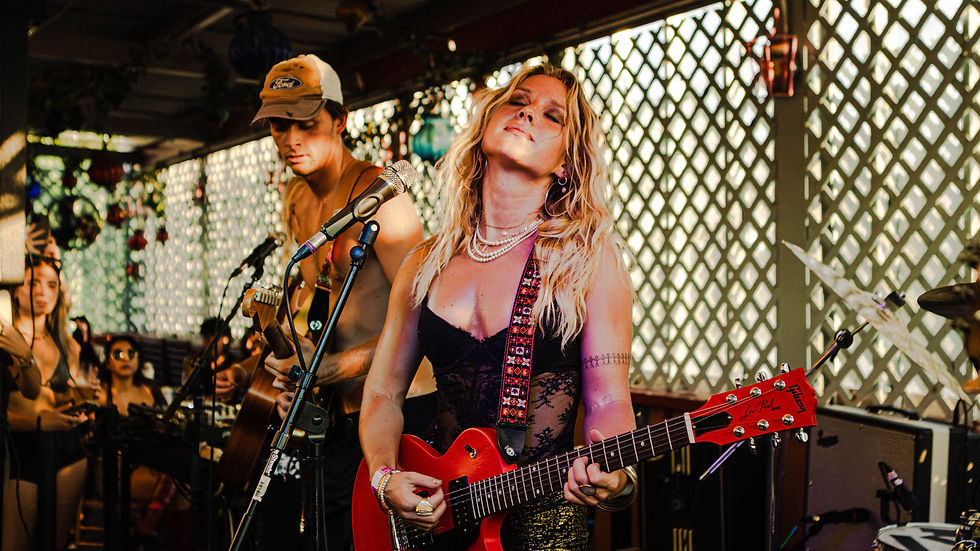
Seeing an artist live that you know will make it big one day is truly something special. On August 16th, at the Sultan Rooftop in Brooklyn, I had the pleasure of experiencing Pearl live. A hot sunny day led to a perfect evening rooftop show filled with excitement and great music.


Pearl, also known as Hope Waidley, originally from Michigan, moved to LA at 20 to dedicate herself to her career in music. Traveling with her sister, Clara Waidley, throughout the country, trying to find a sense of stability amidst the craziness of performing and moving around. She is a singer-songwriter who’s passionate about writing songs full of vulnerability from her experiences, accompanied by breathtaking vocals. Listening to her music, you hear her stories sonically, told through bold lyricism and intriguing instrumentals that draw influences from older alternative rock. 


My own discovery of Pearl was through TikTok, her user @unaestheticsurferpearls, where she posts candid videos, promotes her music, or famously, surfs in platform heels. The promo for her single “No Man” caught my attention, a song about the importance of wanting to be independent and separate from a man. Not relying on them to feel good or valuable, but rather finding that value within yourself. Once the song was released, I knew Pearl was an artist I would continue to love. Her raspy vocals, emotional delivery, a very 70s rock-inspired sound, and vivid lyrics captivated me. 


Arriving at the venue and seeing fans all dressed in the same style as Pearl was heartwarming. Micro shorts, cheetah print, eclectic jewelry, and heels surged on the rooftop. Not only does this show the love and appreciation for Pearl, but it also shows the community that is brought together. This has become one of my favorite things about going to concerts recently. There is a certain aesthetic to an artist that fans see, then show up and show out for them!


As her band began playing, Pearl danced with fans before getting on stage to sing “I Like You But.” A small gesture connecting her to the audience. The energy at just the first song foreshadowed the rest of the show's liveliness. She jumped around the stage, whipping her hair, then introducing the crowd to her vocals. While mesmerized, we all jumped and sang along with her. Onto the second song, “Hungry,” which showed her range in style and stage presence. More of a groovier track, Pearl’s yearning vocals blended beautifully with the instrumentals.


“Fuck It Up,” released earlier this year, further proved how much she loves engaging with the audience while performing. Letting the crowd sing the chorus and dancing along with us. Pearl’s band went nuts, showcasing their individual talents. Drummer Devin Robinson keeps a steady beat as the lyrics speak for themself, and guitarist Kyle Blackman and his guitar solo command the stage.

Photo Credit: Adriana Rivera

An unreleased track, “Groupies,” continued with that 70’s rock vibe, with Marley Striem showing off deep bass lines blending along Blackman’s riff-driven guitar, creating a harmonious blend of grooves. Robinson thundered behind Pearl, sonically emphasizing her eccentric dancing and headbanging. 


The fifth track, “Wonder,” truly displayed Pearl’s ease in switching from a more upbeat, exciting song to a slower, more vulnerable side of her discography. With raw lyricism, her vocals shone during this performance. Emotion was palpable with every line she sang. So much soul in her delivery, with just an outright beautiful melody. Then, a bass solo that soothes the crowd as enticing drums continue. 


Another popular single released last year, “Methamphetamines,” sent the audience into an uproar. A song depicting an unhealthy, strenuous relationship, where the storytelling in the lyricism alone keeps you hooked—and even more so when you hear it live. Pearl’s level of emotion in singing the track was like she had just written it. Feeding off the high energy from the crowd, Pearl and her band only grew more enthusiastic in their performance. The well-known guitar riff in the song left a lingering sense of needing to hear more, along with the unapologetically truthful and stimulating performance. 


Pearl covered the one and only Lana Del Ray’s “Radio,” which naturally made every girl in the audience melt while singing along. A version with a grungier electric guitar added, the instrumentals were strong. While admiring the show, I think to myself, “Many aspire to have the stage presence she and her band have.” Effortlessness in captivating the audience, dancing full out for each track, and all around, a performance you get lost in watching.


Photo Credit: Adriana Rivera

“Passenger Princess” is a newly released, slower ballad including Pearl's raspy, yearning vocals. An emotional chorus depicts the want for a healthy relationship, but it falls short: “All I want to be is your girl / But here I am being more of a man than you.” Her sister, Clara Waidley, on backup vocals, harmonized beautifully as Pearl put all of her energy into singing the bridge. 


As a short interlude, in each show Pearl chooses a ‘princess’ from the crowd to come on stage, wear a tiara, and deliver a speech. Such a fun, exciting way she connects to her fans and allows them to be a bigger part of the show. An instrumental plays in the back as the chosen princess spins on stage and embraces Pearl. She emphasizes the importance of showing up for yourself and never changing for anyone. As the crowd cheers her on, the energy in the room shifts from eager excitement of the show to a moment of connecting to the music and the community created.


Photo Credit: Adriana Rivera

During an unreleased track, Blackman on the guitar shreds a sick solo while in the background, you can see Pearl pouring red wine into her bandmate's mouth. Chaotic energy that only continues as the princess of the night returns to the stage. They were just having fun. Hot girls having fun. That’s rock and roll.

Photo Credit: Adriana Rivera

Nearing the end of the show, everyone on stage was sweating from how humid it was on the roof, but they played through it. A cover of “That Smell” by Lynyrd Skynyrd left me feeling sonically elevated. The drums powerfully lingered after each hit, having us all jump and dance around. Pearl’s vocals blended with the guitar riffs, creating a conversation within itself, something beyond verbal communication. Music can communicate in unique ways, especially when performed authentically.


To end the night on a high note, Pearl finished with “No Man,” her most-streamed track released at the start of 2024. This song resonates for many, calling out the girls with so much love, strength, and fire in their hearts to recognize they are more than staying with a man who dims their light. The famous chorus goes, “I don’t want to worry ‘bout no man / No man, no man, no man.” This is part of the show where she calls girls to come on stage to sing the song. “First come, first serve!” she yells. Naturally, everyone swarmed onto the stage, blending in with the band. On an elevated surface higher up than the stage, Pearl began her song, and everyone on that roof and stage screamed along with her. Yet again, a beautiful way she connects to her audience, her people. That last song tied the whole night together for me. So much passion and energy exuded from her even after an hour set in the heat.


The Let Girls Be Hot Tour was engaging, impressive, and so fun. It was an honor to watch Pearl in person and deliver such a raw and exciting show for Brooklyn. There are artists who are on stage for the hell of it, but with this show, anyone would be able to tell she truly loves to perform and connect with people. To me, that is what music is about. Connection. In every capacity.


Keep up with Pearl’s latest song releases and follow her socials. You wanna be able to say you were here from the start!


Written by: Amy Kapel

Photography: Adriana Rivera

You reached the end! Make an account to get updated when new articles and interviews drop.

bottom of page