top of page

After spending 4 years in film school, walking out with abundant knowledge about the history of film, experience working with the university’s Blackmagic camera, and using words like mis en scene when discussing films, how do you have your movie? How do you get a film into Sundance? Where do you find your funds? Where do you start?

If privileged enough to receive a formal education in filmmaking, the curriculum always seems to forget to include key details on making a film. As major studios live in the past coming out with reboots and remakes, how do filmmakers tell their original stories independently?

While studying at Northeastern, Catherine Argyrople discovered her passion for storytelling. Instead of going to film school, she opted to go to the best place to learn how to make movies and film sets. By graduation, she had worked on various productions and made several short films.  She took the knowledge from those experiences into producing her debut feature, Growing Pains.  The film follows two childhood best friends the summer before their freshman year of high school, capturing the hardships of growing up and friendships fading.  

After a long 3 year journey, the film had its world premiere in Argyrople's hometown at the Boston International Film Festival. I had the pleasure of talking with Argyrople to discuss the challenges independent filmmakers face and the creative freedom to provide representation where Hollywood lacks.


Growing Pains addresses hardships most often faced in adolescence (and often follows us through adulthood), such as mental health, sexuality, and drifting of friendships. What was the process of building these characters’ stories authentically?  

I am big on authenticity– it informs how I show up in the world and my work. I wanted to create a diverse and authentic story about teenage girls that shows two unique life experiences that feel true to key struggles and themes that young women face in their daily lives. I am grateful that my writing partner, Mariana Fabian, had a similar passion for authentic representation. We both felt that many depictions of teen girls feel very inauthentic to real life. Whether that be from overdramatizing storylines and events to harmful portrayals that oversexualize or age young girls inappropriately, illustrating girls in these inaccurate representations in the media has major implications for negative cultural and societal impacts. It was important that we showed our characters, Zoe and Nat, in an honest light with sensitivity to the subject matter, as they are both seen in intimate emotional and even physical portrayals. 

We casted teens to play teens instead of casting adults. While this created more restrictions for me as a producer and writer, this was something that Mariana and I felt very strongly about, and we were not willing to compromise for the sake of authenticity. Similarly, we casted people who could represent the backgrounds of the characters that they played. The most special thing for me was casting Molly Morneweck to play Zoe’s character, as she had a similar medical background to me as a cancer survivor and the same scar as myself, as well as the character.


Few films offer a true and honest representation of teen girlhood. What are some common mishaps mainstream media makes when telling female coming-of-age stories? What essential themes were you determined to have depicted accurately in your film? 

What a great question! My writing partner, Mariana Fabian, and I wanted to tackle this ambitious and personal film with an authentic lens, in terms of the representation and how it portrays teen girlhood. Oftentimes, movies about young women aren’t written or directed by women themselves, which can be quite toxic depending on how they are depicted. Teen girls are often oversexualized and portrayed from the male gaze, and many times in mainstream media, these actors are adults playing children. All of this can create really harmful representation!

While many are blinded by the glitz and glam of big Hollywood studios such as Paramount and Universal, independent filmmakers lack the funds and resources compared to these big studios. What was your experience producing this film? 

It is my dream to work with incredible studios like Paramount, NBCUniversal, and Disney one day. They make incredible work and

provide many great resources to their teams and filmmakers! This is most definitely true about independent filmmakers having limited resources. Many independent filmmakers, including myself, are self-financing their projects and relying on grants and crowdfunding campaigns to be able to tell their stories. I used the money that I saved for film school to instead make a feature film, which was one of the best decisions that I have made in my professional career. While it would be amazing to go to film school and receive an MFA, I really wanted the opportunity to tell a personal and special story to me and to be able to have the creative autonomy of directing, writing, and producing. We also received so much community support from a successful crowdfunding campaign with 100 supporters and 4 grants from the Massachusetts Cultural Council, which is where I am from and where we made the movie.

I am extremely proud of the movie and I know that we did a great job of creating this movie with limited resources and bandwidth. I have poured so much into this film over the past three years and I am so grateful that I had the opportunity to make this film. The film was quite ambitious for a microbudget feature film debut– shooting over 21 days in 9 locations with 110+ people, including on the water! If we can make an ambitious feature film completely independently, imagine what we can do with ample resources!  


Hollywood being a male-dominated industry, it is not often you hear of a film crew made up of a majority of women and nonbinary filmmakers. How do you think the collaboration with a crew that reflects the characters on screen translates into the film? 

I feel that it is important for women to have the opportunity and platform to be able to tell female-centered stories. So often, stories of women and girls are written, directed, and produced by men. We felt that it was important to tell this story about girls with a team of women. I am proud that the film was awarded our ReFrame Stamp by Women in Film and The Sundance Institute for gender-balanced hiring, as over 80% of our crew was female or non-binary! 

I think that this female-centered, inclusive lens had a large part in creating a safe space for my actors to feel comfortable and supported on set, especially when dealing with sensitive subject matter surrounding mental health, sexuality, and intimacy. I heard a lot of great feedback from my team that they felt like this environment for filming was quite positive, especially compared to other sets. For sensitive and intimate scenes, we had a wonderful intimacy coordinator present named Kayleigh Kane who was incredible and was instrumental in helping my actors feel safe. 


Not only did you shoot in Boston, but having the film premiere at the Boston International Film Festival.  How does it feel to share your debut feature with your hometown? 

It was so special to world premiere back at home in Massachusetts, where we filmed the movie. We had a wonderful turnout at both our premiere at BIFF and our Community Premiere that my team planned independently at the iconic Somerville Theatre. At the Community Premiere, we had over 400 people on a Tuesday night! The house was absolutely packed and the reception of the film was overwhelming, as I felt so much love and support. People were laughing, crying, clapping, and cheering! It was wonderful to see that after three years of hard work and dedication to the film.

The premieres also showed me the impact of the film on the lives of our community members who helped make this film a reality. I was very moved by people’s feedback, hearing that Growing Pains was their favorite set and professional experience in their careers. It also was quite fun to chat about the film at the Community Premiere with Alecia Orsini Lebeda from Women in Film & Video New England, who moderated the Q+A. Lastly, a big highlight was meeting my writing partner and associate producer, Mariana, in person. We had been collaborating remotely over the past three years, so this was a very special opportunity to celebrate our work in person with the people who helped us make our movie. 


There is a longstanding debate among filmmakers whether or not film school is worth the investment.  What advice would you offer young filmmakers who may be questioning if they should make this investment?

I honestly think this is a really personal decision and each individual will have a different feeling about it. As I mentioned above, I decided not to go to film school and make a feature film instead. I believe that this was the right call for me, but I had extensive film production experience before embarking on this journey. I had wrote, directed, and shot a number of short films, as well as worked in the corporate film world and on a number of sets. I am also a very motivated, driven person with big goals and ambitions. 

I don’t think that making a feature film is for everyone, and I was actually advised by a mentor of mine to make a short film instead of jumping to the feature. I didn’t feel that making a short with Growing Pains was the right call for my story or career, as I actually made Growing Pains as a spec for a television series. Having some significant experience in shorts is a really helpful background to have before making a feature. I think film school can provide a wonderful education in film from seasoned professionals, as well as a great team of collaborators who you will learn and grow with. The networking and resource aspect of film school is incredible. 

My advice would be to ask yourself, “What feels like the right direction to go for your story and your career?” If you feel strongly to write and direct and/or produce, I suggest making your film independently. In film school, you typically pick a specialization and you wouldn’t have the same creative autonomy on a project. I would also find great collaborators who are going to help you realize your vision, supporting you along the way. Lastly, I would encourage you to pursue what makes you the most passionate. When embarking on a film, passion and drive are key as you will be working on the film for years potentially. 


After completing your debut feature, what have you learned from this experience that makes you feel better prepared for your next film?

I learned so much from making a feature! It was the best “film school” experience for me. I learned how to be a better collaborator and leader, which has aided me in every area of my life– personally and professionally. I learned when to take important feedback from others and when to stick to my original vision, as everyone on the team has a valuable perspective to add! I also learned how to be a better director, articulating my vision and story with more clarity and complexity to my actors. I am in pre-production on a TV pilot, Getting Back Out There, and in development on a coming-of-age surfing drama feature film. I feel my experience with Growing Pains has taught me so many lessons and learnings that I will bring with me and build upon for my lifelong career in the arts. 


Stay updated on Argyrople's journey on Instagram and her website.

Be sure to check out the Growing Pains Trailer and stay updated by following their Instagram.


Written and Interviewed by Ashley Murphy


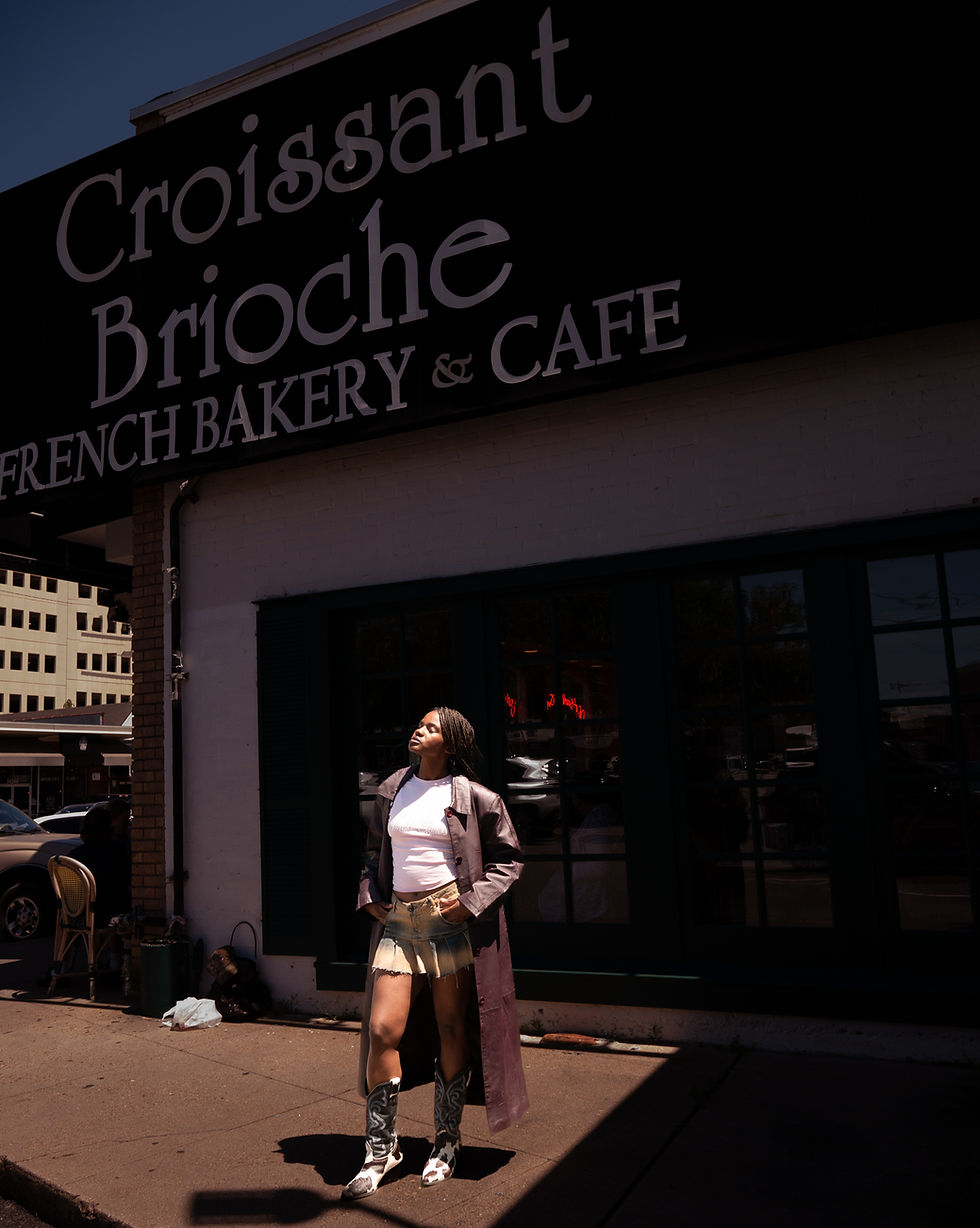
There aren’t many French restaurants in my part of Texas, but tucked into a part of town just outside of the city is a small French cafe with quiet spaces and a lovely lunch menu, that I met with Johanna Makabi, who I briefly passed at a picnic the weekend prior, speaking French a table away with children that my semester and a half of French 101 only slightly prepared me for, before getting fully acquainted over Instagram.  


Which led us here, It’s a sunny day in April, and the cafe we’re standing in smells of croissants and freshly baked bread when I meet Makabi, Filmmaker, producer, and as I'm finding out, a fashion icon.


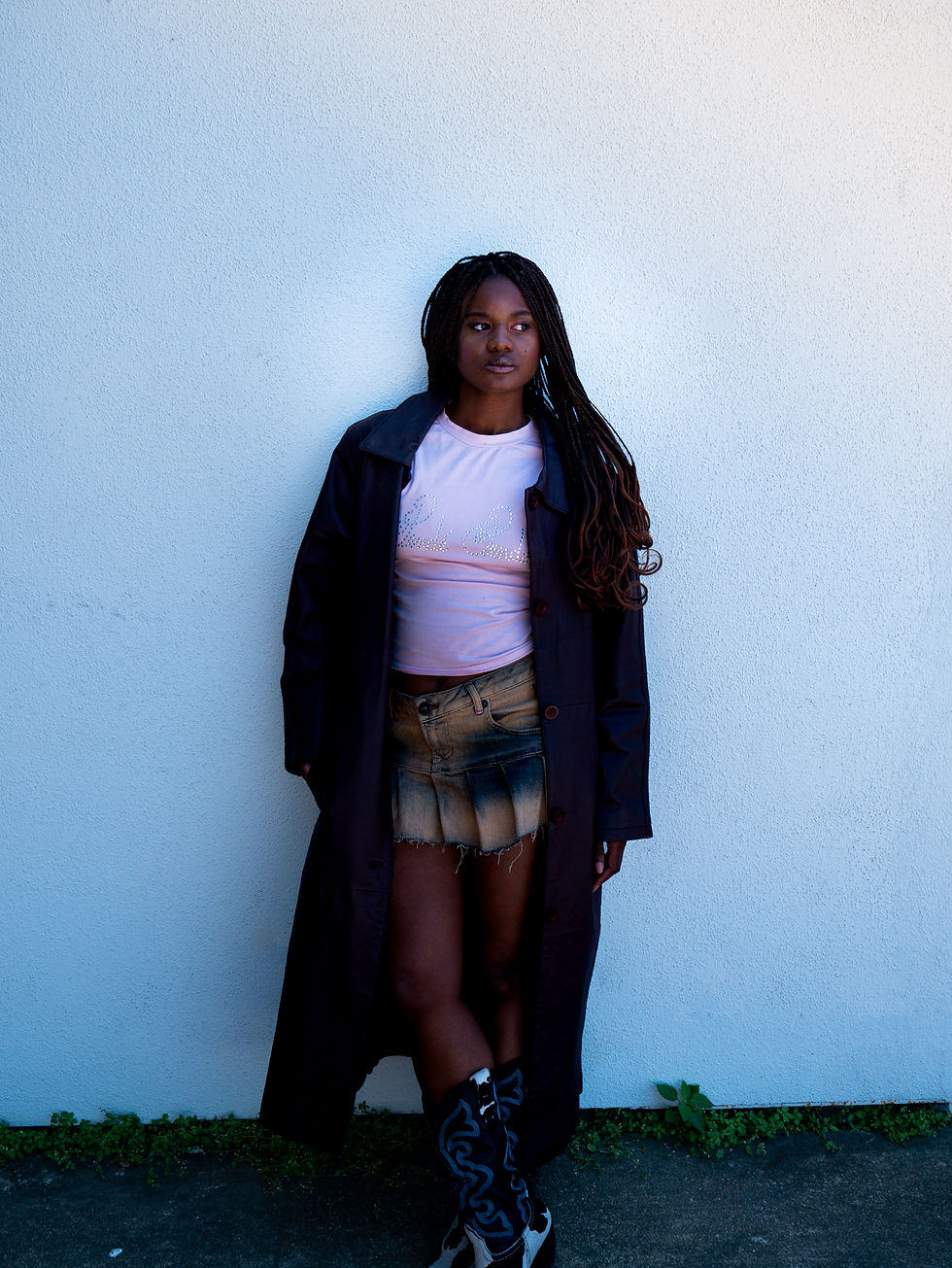
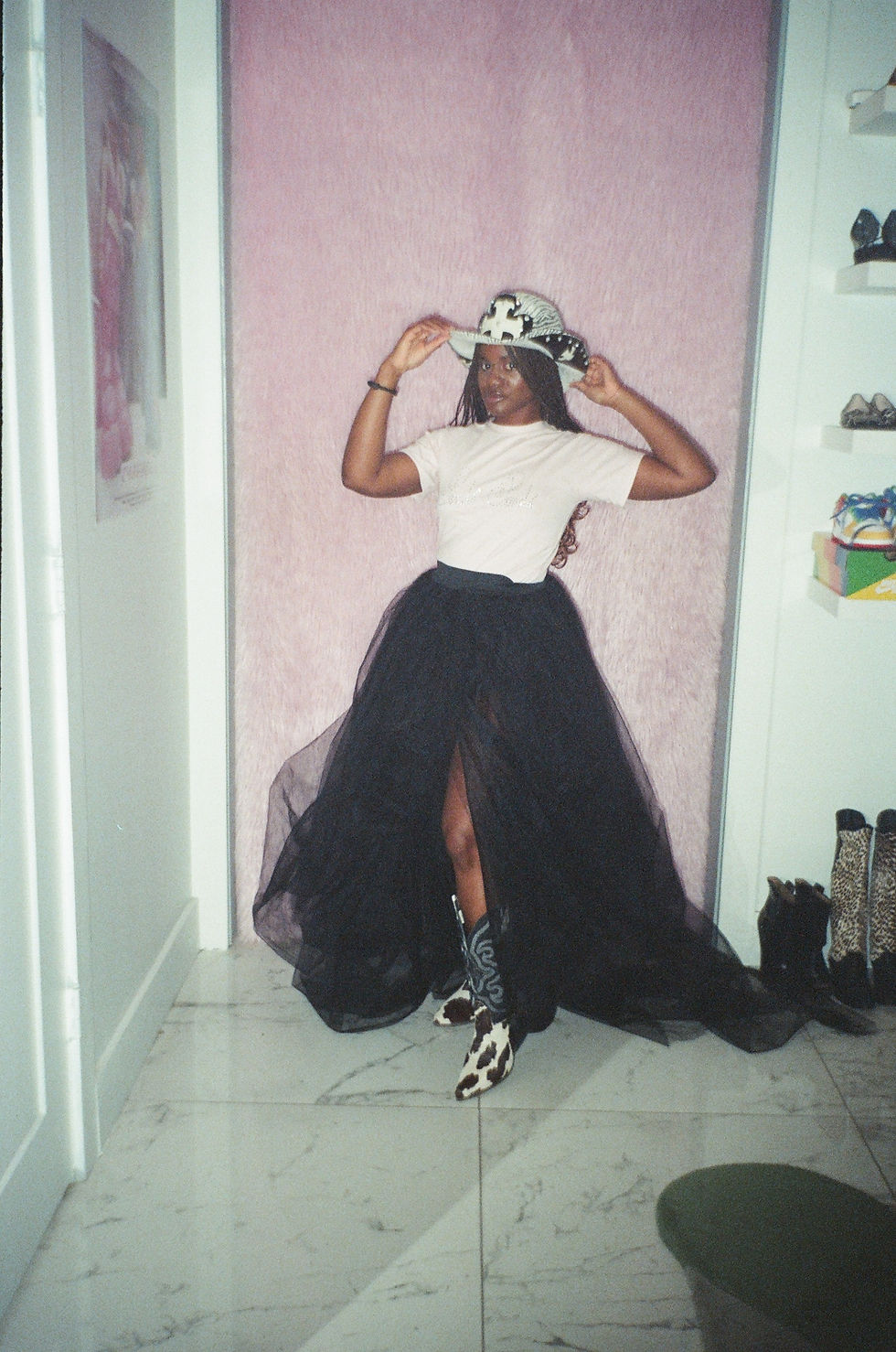
Makabi stands across from me in what I’m almost 100% sure is on my style inspiration board, and yet she wears it so simply and authentically. Curated in a thrifted early 2000s mini skirt, and a blinged out pink  “pende pende” shirt from the designer Fatoumata Guirassy, who worked at major fashion houses before opening her own brand GuerasFatim, a woman-owned brand achieving the reclamation and idea of female empowerment and freedom in fashion. Styled with a gorgeous long brown leather coat, matching brown and pink Von Dutch hat, and a very on-par pair of cow print boots.


We order at the front of the cafe and sit at a back table near large windows that are bringing in enough needed light, that the rhinestones on her shirt make everything around us glow. 


Without realizing it we begin talking about our respective star signs. Makabi, who’s a Sagittarius I would later find, advises my earth sun sign, and as we wait for the rush of the crowd to die down we chat about starting on a new production and how the two, astrology and creating, often combine in spaces. She begins and I am in awe at how she has the grace  and wisdom of someone who’s been doing this for decades, but the truth is she only made her debut film less than 7 years ago 


Makabi, who serves as both a Filmmaker and producer, sometimes prefers to serve other people's vision rather than being the center of attention.


“The most important thing is to finish the film. It is a very difficult task to be on set as the director because you have to answer everyone's questions and deal with everyone's energy”.


Our blueberry scones arrive, along with Makabi’s smoothie as she continues,


“-but at the same time, it is where the magic happens, you know? It's also so beautiful and moving. But I'm a cancer rising, so I'm a very empathetic, sensitive, and intuitive person, who is always trying to nurture other people which could be overwhelming on set. So sometimes I'm like, I can’t deal with all of this energy. So the best part for me is when the film is done and you just have to deal with what you have.”


This isn't the first time Makabi surprised me during our day in Rice Village,  and before our coffee was ready I knew, without a doubt, this wouldn't be the last. 


Makabi, whose mom is from Senegal, and dad is from Congo, grew up in Paris.


“I was born and raised there. They met in Paris. I mean, I always say I'm like a real Parisian in the sense that Congo and Senegal are so far away. It's like the equivalent of France and Russia. It's very far. So the chances they could have just met in Paris was fate, and yeah, all my friends always say that I'm typical Parisian, so I take the credit for that”


Although she began studying cinema later on, growing up in Paris the culture of the city offered perfect ground to cultivate her love for the craft.  


“Paris French is a very like Cinematic City. You know, there's a long history of cinema, and I had access to cinemas around that were really close to my house and very cheap. So I was lucky enough to grow up in a city where culture is very important and very accessible to everybody.”


Neither of her parents worked in the industry, but her mother worked for years at a famous salon in the center of the city and often brought home stories of the movie stars and celebrities that crossed her path, that tackled with her love for Film and TV as a kid lined that path perfectly for what would soon become her dream job, but it didn't come without its growing pains.


“And at some point, like after three years working for free in the industry, my friends were always having that joke that when I was saying, I have a new job, they were like, Are you paid now? Like it was a joke? and then, yeah, I became a casting director in the industry, and luckily the first feature I worked on became very famous.”


Makabi is referencing the 2020 title, Mignonnes, or Cuties as the American viewers know it, available on Netflix, and directed by Maïmouna Doucouré, which she worked on the casting for.


The award-winning film that would go on to win awards at Sundance, and César, as well as be on the Oscars Shortlist for International Feature, not to mention the internet controversies, all came together to solidify her spot in the industry. 


She continued her journey, by going back to school to study production and get her grounding as a producer. After, Makabi went on to produce smaller productions and her own projects. 


“I'm Sagittarius, so I love to be free. And so I was like, I'm going to make my own films.”


Makabi with her new knowledge and free spirit, co-founded her production company, Sirens Films, with her sister, the two naming it in part, after their mothers' initials, her parents' conjoined name, and their emergency to tell the stories of those normally forgotten, which leads us here. 


Makabi, in 2018 met a New York filmmaker while in Paris, Malique Moore,  and produced one of his films, Keeping it Reel, a story about the black experience and queer culture, took a trip to New York for the first time after seeing his love for the city and wanting to venture into the place she had heard so much about, spent three months there. One day while taking pictures in the subway, she met a young ballerina, Sabrina Marie Ramsey, who would soon become the subject of her new documentary.


“ I just filmed her with my camcorder in Harlem. it was very low-key, with no budget. And she told me about her story, her family was from Texas and Louisiana, and they had land, that she was the only heiress of, and her family they were like from the black cowboy culture, and it was before Beyonce, it was two years ago, and I thought all of it was very cool”


This then led her to apply to Villa Albertine, a prestigious artists' residency program, and become the first filmmaker without a feature to be selected for the program. Allowing her the opportunity, to travel to the US and expand on Sabrina's story, and stories like hers.


“I had the opportunity to come here and do research for a future film that I want to make.  I really want to talk about Black POC people in the countryside, about the appropriation of land, the immigration or migration from the country to the city, and all of the issues that follow that. I think it resonates so deeply with my parents story and the stories of Africans in Europe in a way”


Being the first, in so many aspects, doesn't come without its challenges, as Makabi details,


“I'm first generation growing up in France, so we have as young first generation creatives from France, We have this burden that's somehow similar to in the US, black creatives had during the Harlem Renaissance, where they had to address and change the representation of black people in America and really set the tone”


Even with the years of culture and identity that have made its way through and from black culture, it hasn't been the same for those across the world.


“And even though it's still hard [in the US] in France we don't have any [Represantaion], So I feel like me being here is like also studying how people, like black people in America, made it. You know, how they make their own black culture in a country that was hostile to them.”


With all that we’ve spoken about, I wondered what that shift must have been like going from Paris to traveling the States.


Makabi who has been going back and forth now for two years, details the issues and joys, 


“First thing was, it's amazing because there are so many issues of being a black person in America that you guys surpass [comparad to] us.”


She talks about the need to still validate her French roots, and the struggle with representation even outside of the  film industry,  


“In France, we still have to say, I was born in France and I'm French to French people. You know, when France is like the country in Europe where there's the biggest black population of black people outside of Africa, in Europe, it's like we have the most important African community, yet we have very poor and bad responses to French black politicians in media and as a population.”


“We have very few famous black people, and almost have no representation in the media, in the mainstream culture. And people still like think that we're going to go back to our country, you know, So this is crazy. When you come here and people are talking about race openly; because blackness is not as celebrated freely”


We discussed for a while the changes and misinterpretations not having representation can take, 


“It's not rooted in the strength, and the beauty in differences”  Makabi continued, “I think like being from three different cultures, I have so much good stuff from those cultures and have so much to share about that. And making films is that, having inspiration from that”


We also spoke about the different quality of life provided compared to France, 


“The quality of life is different. We have more time. I feel like in America, people don't have time to live and I feel like to make art, you should live”


Despite, its challenges with representation and identity, Makabi details how important living and creating in France has been because of its access to life compared to America.


“You should live. You should be able to procrastinate, you should be able to take your time to think. And here people are in an emergency to make money, which is very sad and hard for me to witness this among young creatives because I was so lucky, I had the time. Being in the residency gave me the amount of time in another country to really create art”


So making the shift from casting director to producer to directing, and the shift from that side to this more creative hands-on side, what was that like for you?


“I think it was the best time.”  Makabi responds, “If you want to be a filmmaker, you have to be willing to put your guts on the table.” 


“You have to be able to say, okay, maybe I'm going to make a story about my mom, and maybe my mom is going to hate me, but I need to tell the story. - you need to have this need” 


A lot of people in this society, think they want to be famous. They think they want to make films. They think they want to do that. First of all, you don't make it to make money because you might not make money for a long time. And second of all, you don't make it to be famous, because you might never be famous, you might do your film for 50 people, you know, and 50 people are going to follow your career for 15 years and you should be happy with that.”


Makabi continues, “This is why I feel like it is very hard to be a filmmaker and you need to be committed, to your vision to be like, I'm ready to be hated, to face critique, I'm ready to face being loved even, you just never know.”


Makabi’s newest project, working through the Villa Albertine residency, follows Sabrina, and her journey between New York, making her mark as a ballerina, and Louisiana, saving her family's land.


With this project being much different from her other shorts, I was curious as to what impact she wanted to leave on her audiences.


“I think in the past I just made films that I needed to see. For me, at the age I was, - I just made the film that resonated with the questions that I had at the time, and the frustrations that I had. I just made films for my younger self and for my future self also to reflect on”


“I love to say that all my films are about ghosts, so it's always about the absence of something, and looking for something, looking for self maybe” 


Makabi doesn't go on this journey alone, collaborating when she can with different artists, expanding different backgrounds and mediums, for what she believes is a necessary part of the artist experience, building community.


“I think it's important to know the creatives of your time in order to perfect, to be better, to reflect, to make art, you know. -  Because art is community artists, are family.”


Makabi expands on how that has been changing over the last few years and shifted what it means to create art and community.


She says, “Making content is not like making films. I want to tell that to the next generation. Content is not making art it’s making content. You are playing with capitalism, and capitalism is about creating a lot of volume of images. What I'm trying to do and what we should all try to do when we make art is to make things that can stay in time.”


We speak a bit about making things we’re proud of, and that can allow audiences to enjoy beyond trends.  “Making a film is so hard that at least you should believe in what you do.” 


We shift the conversation a bit, from the ups and downs of culture and lack of community, her favorite color, which currently she’s really into neutrals, and foods, which on the topic she says,


“I love cheese like I cannot live without cheese. This is why I say I will never give back my French passport. Even though I'm like bitching about France all the time, like I'll never give back my French passport because of the cheese cause I love cheese”


She talks for a bit about other things she loves, her mom's cooking which she misses more than anything with traveling, and a new addition to her watchlist, one that's become a guilty pleasure, she feared might get her canceled, but teaches her so much, especially since visiting LA for the first time, Entourage. 


“I think we should watch those terrible things because when we cancel, we forget. We should not cancel. We should be like, watch this, don't do this, don't do this, understand it, don't replicate it.”


When it comes to what she is reading now, besides scripts, she’s been reading Notes About Grief by Chimamanda Ngozi Adichie and The Year of Magical Thinking by Joan Didion, both of which have been helping her in her journey of grief after losing her younger sister, who her next short is about, as well as re-reading the Twilight series by Stephanie Meyer.


“I've been a real Twilight fan since I was a kid, I wanted to read it right now, Being an adult, having dealt with a lot of toxic relationships. And how my view has changed”


We spoke more about the documentary she is working on right now, and the story of this young ballerina, working her way through school and lessons, Makabi noted: “She's the first one for the family to go to New York City, to do Ballet, to become an artist.” “but now she also has this legacy to protect her home, and the land, and uphold both of these legacies”


“I just wanted to follow a little bit of her journey to becoming an artist. When you come from a family where there are no artists it is very hard. So I'm like, Wow, this is so beautiful to see her, like trying to become an artist, a ballerina, which is like one of the most racist and difficult worlds for a black girl, but at the same time having to keep up the family legacy or, you know, family history.”


“I want to challenge those institutions by making films. It's to show that, Look at the stories of the people who are trying to get in. Look at how bright and brave they are, - I want to see that, you know, look like how successful it could be despite everything.”


We break down what it was like choosing a subject for her films that connects to her so deeply, and how precious it is to go into the lives of others and share that space, she states “It should not be just me filming you and then going back with my image and trying to sell them to a festival. I want this experience to have an impact on both our lives. You know, it's not just making a film. A film is a social experience.”


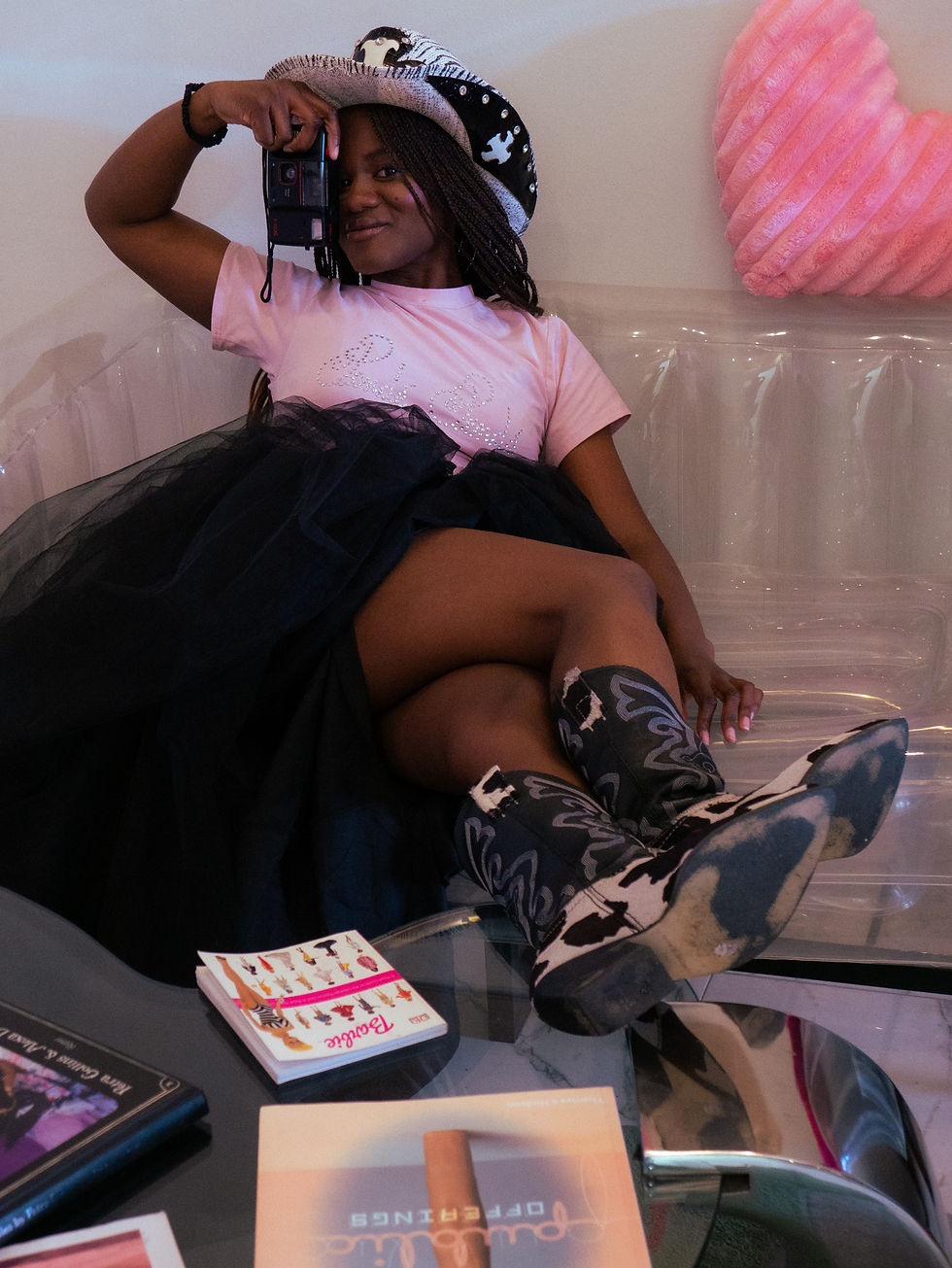
With our plates empty and time to kill, we continued our day running around the shops nearby, Taking pictures in front of paintings, and we couldn’t help but utilize the perfect sunlight outside (this is what happens when you get two filmmakers together), before we made our way across the street to a vintage cultivated store in Houston, Fallen Angel, who graciously let us play dress up in a spontaneous photoshoot inside their wonderfully eclectic boutique.


In beautiful clothes and posing in front of places not intended for art, we found ourselves still creating something. Makabi taking on a level of poise and fashionability in a skirt we both automatically related to Carrie Bradshaw from Sex in the City, a show she has been obsessed with for a while even more so since staying in New York. 


We laugh about the ups and downs of trends, but the timeliness of a good cowboy hat, and the luck we had at finding one that perfectly matched her boots, and ended the day taking photos and waiting back at the cafe for our separate ubers home. 


While we waited, I saved my favorite questions for last, If you could tell your younger self anything would it be, and if you could tell your future self anything what would it be? For any artist, or person in general they are hard to think about, but for Johanna Makabi, she knows exactly what she’d say.


“just don't be so hard on yourself. I trust you; I see you and I love you and keep shining and keep doing it.”


Written and Photographed by Toni Desiree


To smoke or not to smoke? That is the question resonating in the minds of burnt-out college students around the globe. As the decision is made and you either watch your friends roll up (trying to secretly learn from them in the process) or you make the walk of shame down to your plug (Mr. Exotic is a real one), there is another question that remains unanswered…what the hell is there to watch? Lucky for you, I dedicated a whole month of relaxing research as an answer. Here is a curated list of every movie or show I watched while high, hopefully you will too. 


How can a bunch of teenagers high out of their minds laze around without learning from the masters themselves? The quintessential stoner movie, Dazed and Confused is groundbreaking for the way it does…well, nothing. Richard Linklater fondly looks back at the lackadaisical nature of teenhood through the somewhat surreal lens of American suburbia. As tweens shiver in fear of the next chapter of their lives- pop quizzes, pre-calculus, growth spurts (or lack thereof), bulging pimples, the “talk”- they unexpectedly end up in the menacing jaws of older teens who have already been there, done that, and don’t need you getting in the way. Classic all-timer caricatures of pretty cheerleaders with rows of shark teeth, pretentious outcasts, lanky stoners with fast metabolism, dumb boys who probably mean well, and dumb boys who definitely don’t mean well exist as the main source of conflict. Despite their staggering circumstances on the public education food chain, what binds these stupid kids together is booze and boof. For those looking to turn their brain off and enjoy some good vibes, this movie is perfect to watch through the haze.


If you’re one of those sick freaks who always asks the rotation to watch a scary movie and always gets told no in response…me too. Let us forget everybody and hold hands, dance a pas de deux, and admit ourselves to the sinisterly prestigious Tanz Academy of Freiberg, Germany. I refer to Suspiria it as a poison dart frog of a movie; the fantastical, other-worldly presentation of fading vivid hues is enough to nab the attention of any unsuspecting cinemagoer from off the street and into the jaws of the murderous witches’ coven that the academy exists as a front for. Dario Argento sets the audience through the eyes of a young ballet student who experiences the worst first semester of her life. While her troubles of uncovering a murder mystery aren’t exactly relatable, the movie possesses you with a truly haunting score that punctures the feverishly dream cinematography. Unfathomably gory, unapologetically bloody, and un….settling, it is truly one of the best horror movies ever made. If you’re a part of the unlucky (but perhaps sensible and sane) population that hasn’t seen this movie, then text that dearly beloved plug of yours and spark up. You can sit back, but you won’t relax during this ride.


Why, oh, why did we lose the art of modernizing Shakespeare? Maybe then Gen-Z would finally have a teen flick that we can milk relentlessly the same way millennials milk Mean Girls. Sorry. Anyways, I truly think 10 Things I Hate About You is one of the most perfect teen movies of all time. Hailed for its star-stunning cast with star-stunning performances consisting of Heath Ledger as the town’s unusually Australian delinquent, Julia Stiles’s radical literary venom, and Joseph Gordon-Levitt’s breakthrough role as a bit of a cutie pie, the movie skillfully keeps the audience on its toes. Through its rotating cast of intensely peculiar character dynamics, the soul of the film’s originator, The Taming of The Shrew, is never lost on the audience. As you sit in bed either laughing at the nostalgia of needlessly complicated tween drama, or crying at the infamous poem/title-drop by a girl who hates what she loves and loves what she hates, shake your head at the absurdity of it all, and enjoy the ride.


Lynchian is a term that I find to be overused. It is rare to come across an instance of either reality or fiction where the useless, unmoving mundanity of the everyday collides perfectly with the ever-present lingering nature of the macabre, then fogged up by the hot breath of dream-like mystery. Wild At Heart is one of the more accessible movies by David Lynch due to its very simple concept; the world is hell, find love in it. A couple defined by their unruly antics of skin-tight leather pants, one-of-its-kind snakeskin leather jackets, Marlboros from the age of four, and the oozing sleaze of motel room lovemaking, Lulu (Laura Dern) and Sailor (Nicolas Cage) serve as the representative action figures of a facet of America unknown to itself. Newly exposed sin sticks out the flesh of Lynchian narratives where seemingly good people scuffle with the brutal nature of secret and what it means to exactly be evil in the first place. I will preface this with a warning that the movie portrays graphic themes of sexual violence against women, and Lynch should be generally avoided if things of that nature make you uncomfortable. Nevertheless, there can always be true romance found on the road to New Orleans.


Not everybody has the attention span long enough to sit down and focus for two hours…so sit down and zone out for eight hours straight instead. Nathan For You is a documentary-style reality series following the antics of Canada’s Nathan Fielder as he uses his business degree (that he earned by “getting really good grades”) to help improve struggling establishments. Majority of teens reading this article might recognize his voice from Tiktok; “I hope you’re hungry…for nothing!” The heart of the show’s comedy lies in Nathan’s incredibly awkward persona-but-not-really breaking social boundaries in even the most bizarre social conditions. Ranging from hiring blubbering actors looking to snub an Oscar at a funeral home to a brief cameo of Trisha Paytas in her barbie-bimbo prime, this show is bound to break your brain whether you’re high or completely sober. It is one of the funniest reality shows to grace television; Kris Jenner works hard, but Nathan Fielder works harder. 


Honorable mentions;

  • It’s Always Sunny In Philadelphia

  • Superbad

  • The Truman Show

  • Ghost World

  • John Tucker Must Die

  • Bottoms

  • Bodies Bodies Bodies


Written by Nariyah Gonzalez

Photography by Rose Miller

Talent: Rachel Lucas, Ethan Aronson, Sarah Lake

You reached the end! Make an account to get updated when new articles and interviews drop.

bottom of page